


For most creators launching their first online community, we recommend setting the price at $5 to $15 per month.
That price range is affordable enough for early members to actually take a chance on you, but high enough to create real recurring revenue and attract people who are genuinely interested in participating in your community.
As your community grows, becomes more active, and delivers greater value to members, you can gradually raise that price.
Seems simple enough, right?
Well… Not exactly…
Because a $10 monthly membership might be perfect for a creator building a community around a shared hobby, but be completely out of touch for a business mastermind helping its members land clients worth thousands of dollars.
The right price all depends on who your members are, the problems you help them solve, the level of access you provide, and the role your community plays in your overall creator business.
If you charge too little, you can end up spending way too many hours creating content, answering questions, and moderating discussions for a community that isn’t financially sustainable for you.
So, how much should you charge for an online community?
Start with the $5-$15 per month range if you’re a newer creator that offers a relatively simple community experience, and then adjust that starting point based on the value and/or transformation you can consistently provide.
But in today’s guide, we will answer the free vs paid community question, walk through three common community pricing strategies, their typical price ranges, membership tiers, monthly vs. annual payments, as well as how to raise your prices without losing your early supporters.
So let’s talk community pricing then, shall we?
3 Community Pricing Strategies
Before you ever choose a number, you really should decide what role your community actually plays in your business.
Is the community itself your entire offer?
Or is it actually there to support something else you sell or provide?
The answer to those questions matters because not every creator needs to charge members directly. In some businesses, the community creates relationships that eventually lead to other purchases. In others, the membership itself is the main product and recurring revenue source.
But most creator communities tend to fall into one of three different models: free, freemium, or paid.
1) Free Community With Paid Offerings
In this model, your community remains free to join, while you make money through other products or services.
These offerings can look like:
- Coaching
- Consulting
- Courses
- Digital Products
- Freelance services
- Merchandise
- Events
So the free community becomes the place where people discover you, your expertise, get to know you, and build trust before making a purchase.
This can work especially well for new creators who are still learning what their audience actually wants. Because a free community gives you direct access to the questions your audience asks, the problems they share, and the outcomes they want to achieve.
That is some pretty invaluable market research…
But remember: free does not mean effortless.
You still have to welcome your members, moderate discussions, create reasons for people to come back, and show up consistently. If the community supports paid products, there needs to be a clear path connecting the free community to those products.
Otherwise, you run the risk of accidentally creating another full-time job for yourself that doesn’t actually generate any income at all.
2) Freemium Community With a Premium Upgrade
A freemium model gives members a free tier, while allowing them to upgrade into one or more paid tiers.
This is a great middle ground because it lowers the barrier to entry without forcing you to give everything away for free.
Free members might get:
- Access to general discussion threads
- Community announcements
- Basic resources
- Occasional public livestreams
While paid members would unlock:
- Premium discussions or groups
- Exclusive livestreams
- Courses and downloadable resources
- Open office hours or AMA’s
- Challenges, workshops, or masterclasses
- More direct access to you.
The free tier gives members a chance to experience your community before making a financial decision, think of it as a trial run. If they enjoy the conversations, make connections with other members, and see the value firsthand, upgrading to the paid tier feels like a natural next step.
This ensures it isn’t a cold sales pitch.
And the key is making the difference between your free and paid tiers as clear as possible.
If both experiences feel identical, why would anyone upgrade?
Your free offering should be useful enough to build trust, while the premium option provides a deeper level of access and support.
This is also why I chose a freemium community as the model for Heartless Audio that I built on Sphere.
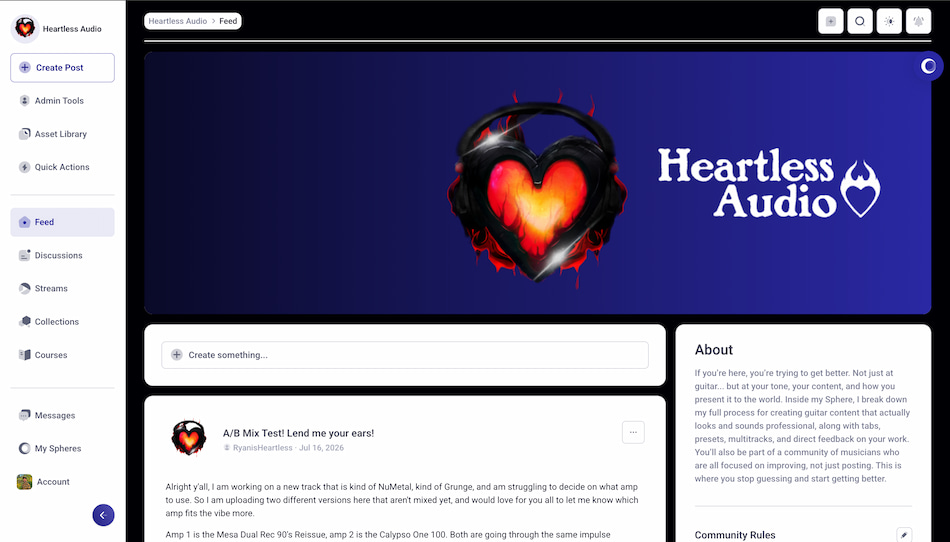
I use my free tier to invite people looking for a community of like-minded guitarists to connect with in my general discussions. Give glimpses of my premium content such as my guitar tabs for original songs and Logic Pro recording templates, and some of my announcements.
My paid tier gives members full access to all of my guitar tabs, templates, tone presets, livestreams, and courses, as well as early access to all of my YouTube videos before they go live.
Members also get access to exclusive discussion threads where they can get feedback on their guitar playing, receive mix reviews, and participate in challenges I do weekly.
I try to ensure that my free tier has great content and features to attract and retain members, but that my paid tier has real and valuable offerings to entice someone to click that upgrade button.
3) Paid Membership Community
With a paid membership community, the membership itself is your main offering.
People pay from the start because they are looking for the experience taking place in your community.
That might include access to you and your expertise, accountability from the community, relationships with other members, direct support, or help to reach a specific goal.
This model can create predictable, recurring revenue, but it also comes with higher expectations from the members.
If the members are paying every month, you need to make sure you give them a reason to keep renewing every month.
This doesn’t mean you bury them under mountains of content, though.
It means consistently delivering the promise that made them join in the first place.
A paid membership works best when you already understand your audience, and can clearly explain the value in one or two sentences. If that promise is still vague, it may make more sense for you to validate the idea more through free content first. Or even a small founding group, or limited beta before committing to a fully paid model.
How Much Should I Charge for an Online Community Then?
Okay, so now we get to the number everyone wants.
As I said at the beginning of this blog, for most newer creator communities, the $5 to $15 per month is a strong starting point.
But here’s the catch…
That recommendation assumes you’re offering a relatively accessible membership centered around your discussions, exclusive content, and interactions with other members.
If you’re delivering more hands-on help, your community price can, and should, be much higher.
And the goal isn’t to copy what another creator may be charging, either.
It’s to find a price point that actually matches the value of your own offerings and allows you to keep showing up without burning yourself out.
Don’t Price Your Community Based on Content Alone
One of the easiest pricing traps is trying to justify your monthly rate by piling on more and more content.
Three videos a week, daily posts, two new courses every month.
That’s a huge resource library that likely no one has time to finish.
And sure, it may look valuable on a sales page, but more content does not automatically lead to a better community experience.
The internet already has more information than any of us can consume in a lifetime.
People join communities because they want something they can’t just get from a YouTube video.
They’re likely paying for:
- Access to you or other experts in your community
- Accountability that helps them follow through
- Feedback on their work
- Relationships with people who understand their goals
- Direct answers to specific questions
- Support when they get stuck
And of course, your content can absolutely support all of these things, but it shouldn’t replace them.
If you base your pricing on how many posts you promise to publish, you create a content treadmill for yourself while teaching your members to measure value by volume.
This is not a great foundation for a sustainable membership, to say the least.
Consider Your Audience’s Willingness and Ability to Pay
Your audience matters just as much as your offer.
A student community, a casual hobby group, and a community for established business owners will have very different expectations around pricing.
Someone joining a group to talk about a hobby may be willing to pay $5 or $10 each month.
A professional joining a community that can help them find clients or advance their career may willingly pay upwards of $100 a month for the right level of support.
And neither audience is better…
They simply value the outcome of the community differently.
This is something I really had to think about when building Heartless Audio, my own Sphere community for musicians interested in guitar, recording, and music production.
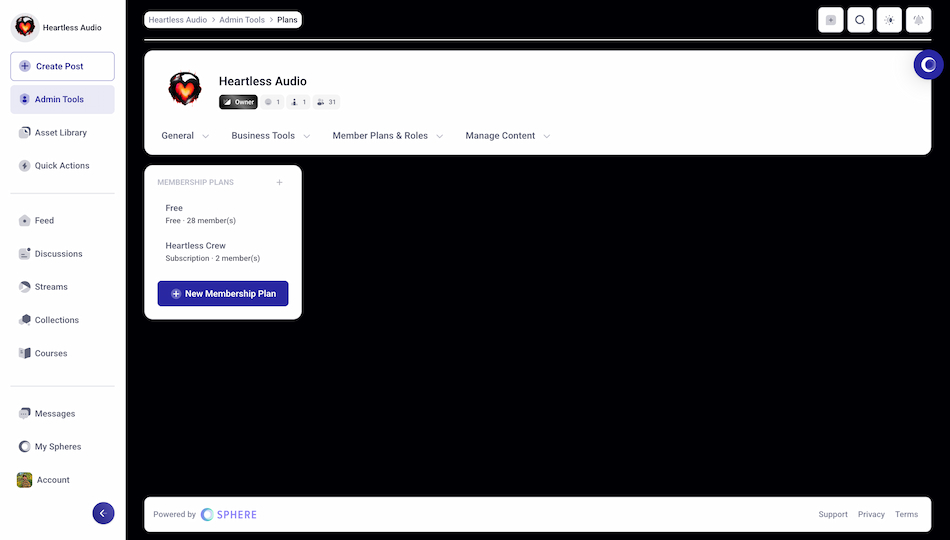
I couldn’t price it like a high-ticket business mastermind just because both offers happened to include a community.
Heartless Audio is for musicians and creators who want better content, feedback, relationships, and direct interaction around their music and guitar playing. The price had to make sense for that audience while still supporting the time and energy it takes me to provide a meaningful experience.
Taking all of this into account is how I settled on the price of $9.99 per month, and I also have the freemium tier available at the same time.
So that is the sweet spot you’re looking for:
A price that feels reasonable to the member and sustainable to the creator!
Price Based on the Problem You Solve
Just like any other business, you should price your community based on the problem you solve, and the value of that outcome.
A casual community for fans of a hobby creates quite a different kind of value from a business community that helps its members earn revenue, find clients, or reduce customer churn.
So, imagine two different communities.
The first helps beginner photographers share their favorite photos and get feedback from other hobbyist photographers.
And the second helps freelance photographers consistently book clients at rates well over $3,000 each.
Both communities can be perfect for their members.
But the second one can reasonably charge considerably more because the financial value of the outcome is so much easier to measure.
The more significant and meaningful the transformation, the greater the potential or perceived value of the membership.
This doesn’t just apply to financial results either…
A community can create valuable health, creative, educational, professional, or emotional results. What matters more is how urgently members want the result, and how effectively your community can help them reach it.
Use Access and Interaction to Increase Value
If you want to justify a higher price, your best levers usually center around access and interaction.
This might mean you need to add things like:
- Live group calls
- Coaching or feedback
- Member workshops
- Virtual or in-person events
- Direct support from yourself
- Open office hours
- Accountability groups
- Personal reviews of members’ work
These additions can make your membership much more valuable because they help people apply what they learn.
Think of it this way:
A downloadable guide can tell someone what they need to do.
But a live coaching call can help them figure out what to do with their exact situation.
And that specificity is invaluable.
Just be careful not to promise more access than you can realistically deliver on. A $100 monthly rate may sound exciting until you realize you’ve created a calendar full of calls you no longer have the time to take.
So your price should support that experience, and the experience should be sustainable for you.
Common Online Community Price Ranges
While there is no universally accepted pricing formula, these ranges can give you a logical starting point:
Free
Free communities are best for creators who are still validating their idea, growing an audience, or using the community to support separate paid offerings or products.
Keeping things free can remove friction and generate real participation, but it needs a clear purpose and eventually a sustainable business model.
$5-$15 per Month
This is the range I recommend for most new creator communities, my own included.
It works well for fan communities, hobby groups, emerging creators, and memberships offering discussions, exclusive content, occasional livestreams, and a sense of belonging.
The low price makes joining feel approachable, while still creating commitment.
$20-$50 per Month
This range makes sense for established creators offering consistent interaction and a clear outcome.
Members may get regular livestreams, workshops, challenges, premium resources, detailed feedback, and more specialized access to the creator.
And at this level, the value proposition should be very easy to understand.
$100+ per Month
Higher-priced communities usually include hands-on support and a meaningful, measurable transformation.
Think coaching groups, professional masterminds, business communities, and memberships with direct access to an expert.
At a few hundred dollars per month, you are no longer selling just a casual place to hang out. You’re selling a premium experience tied to a serious outcome.
Higher prices may also require a real sales process rather than a simple checkout link. Because prospective members might need a workshop, consultation, or discovery call before they feel comfortable committing to that price.
Don’t Be Afraid to Start Small
Thankfully, you really don’t need to find the perfect price before launching your community.
In fact, you probably shouldn’t.
Obsessing over finding the ‘perfect’ price now, may prevent or delay you from just launching the community and finding out what works in real time.
So start with a modest offer that you feel confident in delivering on. Watch how your members use the community, ask what they value most, and pay attention to the results they achieve.
We talked more about this in depth in last week’s blog: “15 Best Online Community Engagement Strategies for Creator Communities”, so be sure to check that out for a deeper dive.
And remember, you can always add features, improve the experience, and raise prices as the community grows in value.
But it is usually much easier to raise a low starting price than to launch too high and have to lower it later.
If your idea is still completely untested, validate it first with free content or a small free group.
The goal isn’t to stay free forever, but to learn enough to charge confidently.
Monthly Rate vs. Annual vs. Lifetime Membership Pricing
Once you know roughly what you want to charge, you need to decide how your members will pay.
You’ll usually see three common options for this: a monthly rate, an annual membership, or a lifetime flat fee.
Monthly Membership
A monthly membership has the lowest upfront cost, and is usually the easiest option for a new member to try.
Someone may hesitate to pay $120 today, but feel perfectly comfortable paying $10 this month.
The downside of this is churn…
Because members can cancel each month, you have to continually deliver value and remind them why the community deserves a place in their budget.
Monthly pricing works best for newer communities, low ticket offers, and creators who want the easiest possible entry point.
Annual Membership
Annual memberships create better upfront cash flow and often improve retention and participation.
Once someone commits for a year, you have more time to help them build relationships and experience the full value of the community.
The higher upfront cost can make joining harder sometimes, so most creators offer a discount.
So, for example, if the monthly rate is $10, you might only charge $100 annually. The member effectively gets two months of access for free (people love their discounts), while you receive a full year of revenue upfront.
Offering both monthly and annual options gives your members flexibility without making the decision overly complicated.
Lifetime Membership and Flat-Fee Access
A lifetime membership is when you charge a single flat fee for permanent access to your community.
This can create immediate revenue and work well for a limited founder launch, a self-contained resource library, or an offer with very little ongoing support.
But be careful here…
Your costs continue even after the lifetime member stops paying. You may still be ghosting events, moderating discussions, answering questions, and paying for your community platform years later.
That makes lifetime pricing risky for a community built around ongoing access.
Use this sparingly, price it high enough to reflect the long-term commitment on your behalf, and be extremely clear about what “lifetime” actually includes.
Community Membership Tiers: What Should Each Level Include?
Realistically, not every community needs multiple membership tiers.
Sometimes, one clear offer converts better than three complicated ones.
With my Sphere community, Heartless Audio, I have kept it to just one free tier and one paid tier, to keep things dead simple.
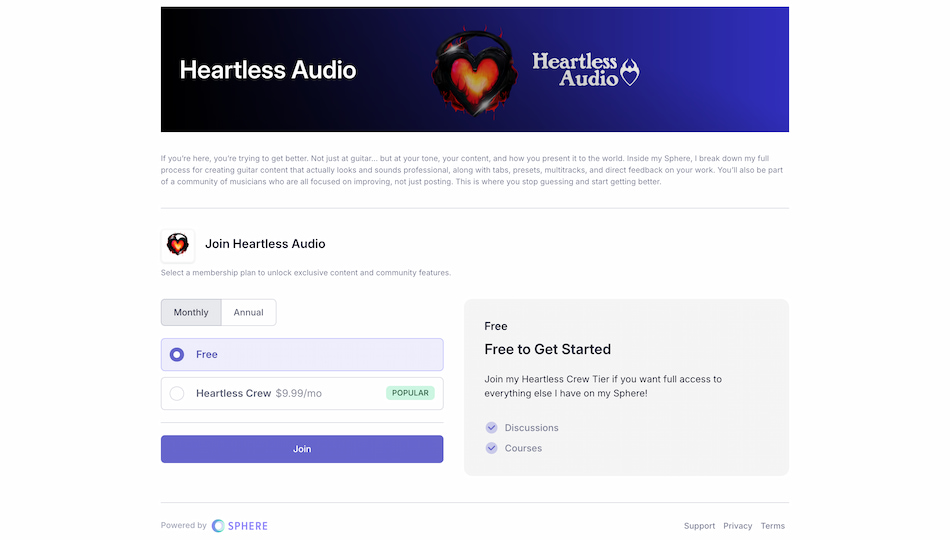
Multiple tiers make sense when each level can serve a specific type of member or offers a truly different experience.
Free Tier
A free tier might include general community access, basic discussions, announcements, and a limited selection of your resources.
Its purpose is to introduce people to the community and help them understand the value of participating, or to drive them toward your paid digital product or offering.
Standard Membership
A standard paid membership could include exclusive content, member-only discussions, livestreams, events, challenges, and premium resources or downloads.
For many creator communities, this is their main offer.
Premium Membership
A premium membership shouldn't simply mean more downloads.
It should usually include more access and interaction as well.
That might look like coaching, open office hours, priority support, small group calls, personal feedback, or more access to you as the creator.
This is yet another lesson I have taken from building Heartless Audio on Sphere.
Musicians can find endless tutorials online for free. But the deeper value of my community is not just placing more videos behind a paywall.
It's giving my members a place to ask questions, share their recordings, receive feedback, and talk to other musicians who are out to achieve the same goals.
When considering my paid tier, I would rather increase the depth of that experience than simply increase the amount of content.
So whatever structure you choose, try to keep it easy to understand.
Because if someone needs a spreadsheet to figure out which tier is right for them, you probably have too many…

When and How to Raise Your Community Prices
Your launch price does not have to be your forever price.
Raising prices can make a lot of sense as your membership grows, engagement improves, new features are added, or members begin achieving stronger results.
An active community can become more valuable simply because of more of the right people being inside of it.
This means more conversations, more perspectives, more networking opportunities.
And more chances for members to help each other or interact.
Use a Founder’s Rate
A founder’s rate rewards the earliest people who take a chance on your community.
Those members can lock in a lower monthly rate as long as they remain subscribed, while new members will pay the current price.
This creates a sense of urgency without relying on some sort of face scarcity.
You’re telling people the truth:
Your community is at its lowest price because it is still new, and the price will increase as the experience increases in value.
Grandfathering existing members also builds goodwill. Your earliest supporters helped shape the culture, provide feedback, and make the community more useful for everyone who joins later…
They deserve to be rewarded for that!
Increase Pricing as Membership grows
You can also connect your pricing increases to membership milestones.
For example:
- $20 per month for the first 50 members
- $25 per month for members 51-100
- $30 per month after the community passes 100 members
This gives potential members a reason to join sooner while making the progression easy to understand.
Just make sure the higher community price reflects real additional value.
Don’t just raise prices every few weeks so you can manufacture pressure. Make changes intentionally, communicate them clearly, and give your audience enough notice to make a decision.
Common Community Pricing Mistakes
Now, before we bring this all together, let’s look at a few pricing mistakes that can make even a great community difficult to sustain!
Pricing Too Low, Forever
A low starting price can certainly help you validate an offer.
But staying underpriced forever can quickly lead to burnout, especially as your workload grows.
Make sure to charge enough to cover the time, tools, and energy required of you to serve your members properly.
Competing on Price Instead of Value
You really don’t need to be the cheapest online community in your niche…
There will always be a free Facebook Group, Discord server, or subreddit competing for attention.
Your job is to create an experience worth paying for.
Creating Too Many Paid Tiers
More choices don’t always create more sales.
Too many paid tiers can easily confuse your potential members, and create unnecessary work for you behind the scenes.
So start simple.
Add another tier only when it can serve a clear purpose for your community.
Changing Prices Too Often
Constant pricing changes can make your offer feel and look unstable and lacking confidence to both your current and prospective members.
Keep it simple…
Set a price, give it enough time to learn something, and then make changes based on real feedback and results.
And a pro tip here: when you do raise your prices, explain why. Your members will appreciate the transparency.
Frequently Asked Questions
How much should I charge for an online community?
For most newer creator communities, $5-$15 per month is a great starting point. Communities offering specialized professional results, regular coaching, direct support, or higher touch access can often charge $20-$50 or even more than $100 per month.
Should I offer a free tier?
A free tier can definitely help you lower the barrier to entry while validating your idea and building trust before asking members to upgrade to a paid tier. This works best when the paid tier offers a clearly better level of access or transformation.
Should I charge monthly or annually for my community?
Offering both options is usually better than one or the other. Monthly pricing has a lower upfront cost and makes joining easier, while annual pricing can improve your cash flow and retention. An annual discount can also encourage your members to make that longer commitment.
Can I raise my community pricing later?
Absolutely! Many creators will launch with a Founder’s Rate, and raise their prices as membership, engagement, and value grow. Consider grandfathering in your existing members at their original rate to reward them for being your earliest supporters.
Are multiple membership tiers worth offering?
Multiple tiers can be super useful when each tier provides a clearly different experience for the member. A premium tier, for instance, should generally offer more access, interaction, coaching, and support. Not simply a larger pile of content!
Bringing It All Together: What Should You Charge?
So, how much should you charge for an online community?
I’m sticking to my statement that for most creators starting a simple, paid membership, $5-$15 is the practical sweet-spot to start with.
If you serve a professional audience, solve a more valuable problem, or provide higher access through calls, coaching, and direct support, then the $20-$50 or even over $100 per month may make more sense.
But remember: there is no single correct number.
The right price is the one that matches the actual value you provide today, while giving you enough room to build something sustainable for tomorrow.
Start modestly.
Validate your offer.
Listen to your members.
Then, and only then, let the pricing grow alongside the community.
Last plug here, I promise, but all of this is exactly why I use Sphere for Heartless Audio.
Sphere gives creators control over the member pricing, and supports paid memberships, content, courses, discussions, and livestreams all in one place. That flexibility is one of the main reasons I chose Sphere, because I know I can continue to refine my member experience as I figure out what my members actually need and want.
So if you want to make your own Sphere, click the link to get started!
And again…
You don’t need every tier, feature, or future price figured out on day one. You just need a clear promise, a price you can stand behind, and a community experience worth coming back to.
So good luck, and I’ll see you inside Sphere!