


If you’re a creator thinking about building an online community, you’ve probably asked yourself: Should my community be free or paid?
It may seem like a simple enough question, but I actually think it’s the wrong one.
Because choosing between a free community and a paid community isn’t really about pricing…
It’s about understanding where your audience is today, where you want to take them next, and what role your community itself should play in that customer journey.
So think about it:
If someone has just found your YouTube channel a day ago, are they really ready to pay for a membership today?
Maybe… But probably not.
Now on the other hand, if someone has been following your content for two years, has watched dozens of your videos, bought one of your products, and even regularly replies to your email newsletter, then asking them to join a paid community surely feels like a much more natural next step.
This is why some creators struggle to get members into a paid community, while others seemingly launch one overnight and fill it with paid members.
It isn’t always because one creator is “better” than the other.
More often, it comes down to the fact that they understood their customer’s journey better.
In reality, a free community can be a great way to build trust and learn what your audience actually needs while creating stronger relationships with them.
While a paid community, on the other hand, can become the destination for your most committed and loyal members. The people who want more access, accountability, and a deeper level of support than your free content alone can give them.
This means that neither approach is automatically better than the other.
So the “right” answer depends entirely on your audience, your goals, and how committed you are to making this community part of your business.
So instead of asking whether your community should be free or paid, let’s figure out which model actually makes sense for where you and your audience are today.
Start With Your Customer Journey, Not Your Pricing Model
Before you decide how much to charge for your online community, let’s take a step back for a second.
How does someone actually become one of your biggest fans?
Rarely does someone randomly discover a creator for the first time and immediately pull out their credit card…
Instead, people usually move through a series of small steps, which marketers like to call The Customer Journey.
Now don’t let the name intimidate you, though. It is really just the path that someone takes from the time they discover your work, to eventually becoming one of your most loyal supporters.
Understanding this journey will make choosing between a free and paid community infinitely easier.
The Five Stages of a Creator Customer Journey
Most creator businesses tend to naturally move people through five stages:
1) Stranger
At this stage, the person has never heard of you before.
They don’t know your content, your story, or what you might help people do. To them, you might not even exist yet.
2) Viewer
At this point, they have found you.
Maybe they watched one of your youtube videos, discovered your instagram or TikTok, or even found you on Google.
And they’re paying attention… but they are still deciding on whether or not you’re worth following.
3) Subscriber
Now this is the first real commitment.
They might have subscribed to your youtube channel, joined your email list, maybe even joined your free community.
Whatever that action was, they raised their hand and said, “I’d like to hear more from you”.
4) Customer
At some point (hopefully), all of this trust and rapport turns into action.
They buy a product, book a coaching session, purchase a course, or join your paid membership community.
This is the point where they stop being just part of your audience, and become an actual customer.
5) Superfan
This is where every creator wants to end up.
These are the people who consistently support your work.
They stay subscribed, they tell their friends about you, buy your products.
They show up to livestreams, and actively participate in your online community.
In many cases, these people become just as valuable to the other members of your community as you are.
And that is exactly why communities can become such a powerful part of a creator business.
Why a Paid Community Can Fail Early
Now, let’s go back to the original question:
Should your community be free nor paid?
Well…
Imagine asking someone that you just met five minutes ago to marry you.
It could happen – and stranger things have, for sure – but it probably won’t. That’s too much to ask, way too fast.
So launching a paid community too early can create a similar issue.
You’re asking people to make a huge commitment before they’ve had the time to build trust with you.
Most people need some sort of proof before they pay.
They want to know that your advice is actually helpful and that it aligns with their goals.
That your content consistently delivers the value they’re looking for.
That you understand the problem they’ve been trying to solve.
Only then does paying to get closer to your work start to feel like the obvious next step.
This doesn’t mean every creator needs years and years of content before they can monetize a community.
But for most creators, trust is built one interaction at a time.
And trying to skip those steps usually leads to disappointing launches, low engagement, and the feeling that “nobody wants this” – which can crush your morale in an instant.
But the reality is, those people just weren’t ready yet. And if you follow the right steps, you can get your audience ready to pay for access to your community.
Using Social Content as a Free Community
Here’s something I think a lot of creators overlook:
You may already have a free community… it just doesn’t look like one in the traditional sense.
If you’re consistently posting videos to YouTube, writing a newsletter, publishing blog posts, recording podcast episodes, or showing up consistently on social media, you’re already building relationships with people for free.
That content is introducing new people to your work every single day.
So it is already doing much of the work that a free community would normally do.
This is why I like thinking about content creation and community as two separate games.
Content is the “Attention Game.”
It helps people discover you.
Community is the "Ownership Game."
It helps you build direct relationships with the people who actually want to stick around, rather than doomscrolling.
One brings people through the front door, and the other gives them a reason to stay.
A Simple Customer Journey Exercise
If you’re still unsure whether your community should be free or paid, grab a pen and paper and try answering these five questions:
- Where do people usually discover you?
- Where do they start building trust and rapport with you?
- Where do they give you permission to stay in touch?
- Where do they make their first purchase?
- Where can they become your biggest supporters?
Once you are able to map out those answers, you’ll usually find that the role of your community becomes much clearer to you.
Because the goal was never to force a free or paid community into your business.
The goal should be to build the right next step for the people who already want to keep moving forward with you.
Free Communities vs. Paid Communities: Pros and Cons of Each Space
I think you’ve probably realized by now that there isn’t one right answer to the free vs. paid community question.
Both can work incredibly well under the right conditions.
But both can also fail spectacularly, and the difference isn’t usually the pricing model, but whether the community actually fits your audience or not.
So let’s break down both options, shall we?
Benefits of a Free Community
A free community has an obvious advantage right away:
Just about anyone can join.
This creates little to no friction and makes it much easier for new people to take that plunge beyond following you on social media.
For new creators especially, this can be of huge benefit.
A free community gives you a place to build relationships, answer questions, and figure out what your audience actually needs.
It can also become one of the best forms of market research you’ll ever have.
So pay attention to the conversations happening inside your community.
What questions keep coming up?
What problems are people trying to solve?
What resources are they asking for?
The answers to those questions can easily become your next course, product, or paid membership benefit.
Downsides of a Free Community
Of course, “free” doesn't always mean free, either.
Someone still has to create content, answer questions, moderate discussions, and welcome new members.
All to keep the community active.
And that someone is usually you…
The biggest mistake I see creators make is treating a free community like the finish line instead of a starting point.
Months turn into years, and the community keeps growing.
Workload keeps increasing.
But the business never becomes any more sustainable, and burnout starts creeping in.
A free community works best at the start when it has its purpose of warming up future customers or validating your new niche. Just don’t let it become a full-time job without a long-term plan, okay?
Benefits of a Paid Community
Now, on the other side of the table, a paid community completely changes the relationship.
The moment someone decides to actually pay for access, they are making an intentional commitment.
And that usually means they’re going to show up differently.
Just like when someone pays for a gym membership or yoga class.
They participate more.
They ask better questions.
They actually complete courses.
They even introduce themselves to other members.
All because they’ve invested something into the community.
And for creators, a paid community also creates something difficult to find elsewhere
Predictable, recurring revenue.
Instead of relying entirely on brand deals, ad revenue, or affiliate income, a paid membership can bridge the income gap and provide a real foundation for your business.
All while creating an incentive for you to keep improving your community.
Drawbacks of a Paid Community
Charging money for a community usually also raises expectations.
People aren’t paying for just another space to scroll through, they’re paying for a result.
They’re paying to learn a skill or build a business.
They’re paying for accountability, to meet like-minded people, or simply to have better access to you.
Whatever that promise is, you really need to make sure to consistently deliver on it.
This is why launching a paid community too early can be fairly risky. If the transformation isn’t clear or the audience isn’t ready, even a great and well-thought-out community will struggle to gain any traction.
Two Factors for Choosing a Free or Paid Community
So, how do you actually decide?
I’ve found that almost every creator can answer that question by looking at two things:
Your audience and your commitment level.
Factor #1: Audience Visibility and Trust
This one is simple: Do people already know who you are?
If you’re still building an audience from scratch, your biggest challenge won’t be monetization – it’ll be visibility.
You need more people to actually discover what you do and begin that customer journey we talked about earlier.
But if you already have hundreds of thousands of subscribers on YouTube, a healthy newsletter, or an engaged Instagram audience, then people already trust you.
And if this is the case, you may not have a visibility problem anymore, but more of an ownership problem.
Your audience exists, but they don’t have a dedicated space to support you.
Factor #2: Your Commitment Level
This second factor has nothing to do with your audience size.
It has everything to do with you…
How important is this community to your business?
Is this something you’d like to experiment with on the side? Or do you want this to become one of the core parts of what you do?
Communities don’t magically run themselves.
They need conversations, leadership, and someone showing up consistently.
So if you’re planning to charge people every month, you need to be confident that you can continue providing value to your members month after month.
The Most Important Question: Why Would a Member Join?
Before deciding whether your community should be free or paid, ask yourself one more question:
Why would someone join in the first place?
What changes in their life after they join?
Maybe they become better musicians, or stay consistent in the gym, or finally stop feeling like they’re figuring it all out alone.
The clearer that answer becomes, the easier every other decision to support you becomes.
The Creator Community Crossroads Framework
Here’s a simple way to think about it:
Imagine two lines crossing each other. The horizontal line is your audience.
On the left, you’re still building visibility, and on the right, you already have an established audience that knows and trusts you.
The vertical line will be your commitment to the community.
At the bottom, your community is just a side project, while at the top, it is becoming a core part of your business.
This leaves you with four different paths:
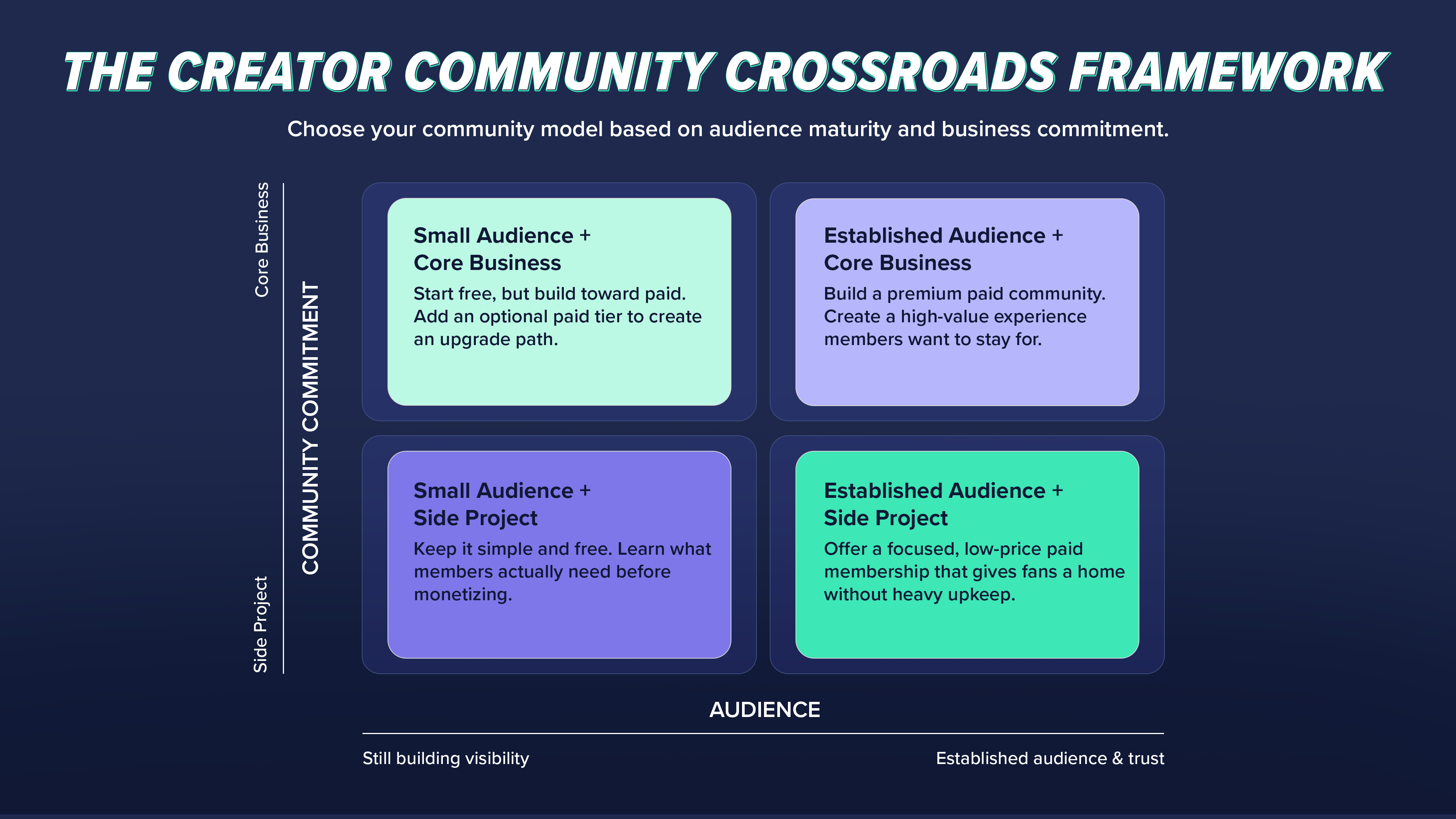
Small audience + Side Project
Here you would start with a free community and keep things simple. Learn what your members actually need before monetizing it.
Small Audience + Core Business
Here you can start free, but build with a paid community in mind.
A free community with an optional paid tier can help you build trust while creating an upgrade path as your community grows.
Established Audience + Side Project
You could likely skip the large, free community entirely.
A focused, low price paid membership gives your fans somewhere to gather without being too much work for you.
Established Audience + Core Business
Now this is where a premium paid community will shine.
Your audience already trusts you, so now your job is to create an experience worth sticking around for.
A Paid Community Should Be the Long-Term Goal
Now, this might rub some people the wrong way…
But for most creators, I think a paid community should eventually be the goal!
Not because charging money is the whole point, but because creating value is.
When people invest financially, something changes in them.
Members and creators alike will become more intentional.
The community becomes more intentional as well, because everyone has a reason to show up.
This doesn’t mean you should charge people just for existing, though.
It means you should charge when you’re consistently helping enough people achieve something meaningful.
Because then you’re no longer charging for access… You’re charging for transformation.
Getting Comfortable with Charging
This part can feel seriously uncomfortable, trust me.
A lot of creators worry they aren't experienced or qualified enough to ask people to pay.
I have definitely felt this way before…
When I launched Heartless Audio on Sphere, I seriously wrestled with this exact feeling. I kept asking myself whether anyone would actually pay to be a part of my community when there was already so much free content on my YouTube channel.

But what I came to realize was that people weren’t just paying me for information by joining my Sphere. They were paying for a place where they could ask me questions, get feedback on their recordings, chat with other musicians, and get more direct access than YouTube could ever (realistically) give them.
And that mindset shift completely changed how I looked at charging for a community.
Because in reality, nobody expects a personal trainer to work for free, right?
Or a guitar teacher, a business consultant. You get the picture here…
They’re paid because they help someone reach a goal faster than they could on their own, and your community can work the same way.
Building a More Sustainable Creator Business
The other reason I am such a believer in paid communities is stability.
Most creator income streams are unpredictable.
Ad revenue changes, brand deals come and go, and affiliate income fluctuates.
Recurring memberships can create a solid foundation, not just financially, but relationally as well.
The people inside your community aren’t there because an algorithm happened to recommend one of your videos (well, hopefully they did…).
They’re there because they chose to be!
And those are the people who usually stick around longest.
This is why I don't think the goal is simply to build a free or paid community, but to build a place that creates so much value, that people can’t help but keep coming back.
Frequently Asked Questions
Should I start with a free or paid community?
This all depends on where your audience is at in their customer journey. If you’re still building trust and growing your audience, a free community is likely the best place to start. But if you already have a large and engaged audience with a clear premium offer, a paid community will make more sense.
Can I have both a free and a paid community?
Absolutely! Many creators will use a free community as they build relationships and introduce new members to their work, all while offering a paid tier with deeper discussions, assets, coaching, courses and more.
How do I know when I am ready to have a paid community?
You need to look for the signals instead of looking at a specific timeline. If members are consistently engaging, asking for more support, asking for more resources, and you can clearly explain the extra value they’ll get, you’re most likely ready to start up a paid membership tier.
Is a paid community worth it?
For many creators, it can be. A paid community can create recurring revenue, better member relationships, and a more sustainable creator business. The key is in making sure your members are paying for something of meaningful value or transformation, not just access to another online space to scroll.
You Don’t Have to Price Your Community Perfectly on Day One
Here’s the good news…
You really don’t need to figure out the perfect online community model before you start.
Seriously.
I think creators can spend so much time worrying about their pricing, number of membership tiers, content calendars, and what everyone else is doing that they never actually build the community at all.
So, your first community might be free.
It might have 15 people in it.
You might then launch a paid tier six months later after realizing that the thing your members actually need is completely different from what you had originally planned for.
And that is totally okay!
In fact, I’d argue that this is kind of the point…
Because the best online communities are able to evolve and adapt because their creators are actually listening to the people inside of them.
So take a look at where your audience is today.
Be honest about how much time and energy you can commit to this.
And most importantly, get yourself extremely clear on why someone would want to join your community in the first place.
Then, you can build from there.
One of the reasons I chose Sphere for my own creator community is that I can offer both free and paid memberships in one place.
I don't need to have every stage of my community figured out today (and let’s be honest, I definitely don’t). Plus, I won’t need to pack up all of my members and move them to an entirely different platform as it grows.
And make no mistake: your community will change.
So will your audience.
Honestly, you will probably (hopefully) change as well.
So don’t obsess over choosing the perfect model to lock in forever, because it doesn’t exist.
Choose the one that makes sense for you at this moment in your journey.
And build the community your members actually need, next. Good luck, and I will see you all inside of Sphere!