


Most creators seem to think that all it takes to keep an online community engaged is simply to post more.
More announcements.
More discussion threads.
More content.
But the truth is, a community doesn’t magically become more engaging just because you post more often!
In fact, I’ve seen communities with multiple posts daily that still feel completely devoid of life.
And that’s because engagement isn’t about how much content you can push out…
It’s about giving people a real reason to participate.
When members start asking questions, helping each other, sharing their wins, and coming back because they actually want to be there, that is when a community starts to take on a life of its own.
Unfortunately, this is where all too many creators get stuck.
They launch their community, welcome a ton of new members, and post consistently for a few weeks.
But inevitably, the conversations slowly dry up.
Posts get fewer replies, and members stop checking in.
And before long, their community starts feeling more like an audience than an actual community.
There’s good news to be had here, though, because it isn’t always because people lost interest.
More often, they just haven’t been given any good reasons to participate.
The most successful creator communities don't rely on constant motivation through endless content.
They’re intentionally designing their content to encourage conversation, celebrate progress, and help their members build real relationships with each other, not just the creator behind the community.
In this guide, I’m going to walk you through 15 of my favorite online community engagement strategies that any creator can use to turn their passive members into active participants.
Let’s get into it, shall we?
What Actually Makes an Online Community Engaging?
The best online communities usually have three things in common:
- Members feel welcome. They know they belong there, even when they’re brand new.
- Members feel connected. They aren’t just interacting with you as the creator – they’re also building relationships with the other members of your community.
- Members feel valued. Their questions, experiences, and contributions all matter to the group.
When people feel all three of these things, participation starts to happen naturally and you can grow a thriving online community.
That’s why every engagement strategy we talk about today is really just another way of creating one or more of those feelings.
Now, let’s start with the first one: welcoming new members.
Engagement Strategies for New Members
The first few days inside your community are incredibly important for the new member experience.
Whether we realize it or not, people make snap judgments all the time. Within just a few minutes of joining your community, the member is already deciding whether this is a place they want to spend their time, or just another notification they’ll need to mute.
Here are some ways to maximize engagement as new members join.
1) Create a Great First Impression
Think about the last time you joined a Facebook Group or Discord server. If no one acknowledged you, there wasn’t an obvious place to start, and everything felt a bit confusing…
There’s a pretty high chance you never went back.
And sad to say, your community is the exact same way.
Fortunately, a warm welcome, a clear next step, and active conversations from other members can immediately make someone feel like they’re in the right place.
By contrast, an empty community or a confusing member experience can cause even the most interested person to leave without ever giving the community a chance.
The easier you make it for someone to participate during their first week, the more likely they’ll be to stick around for the long haul.
Sometimes, all it takes is giving them one super small action to complete, instead of expecting them to figure everything out on their own.
This first interaction will build momentum, and momentum can be the difference between someone becoming an active member of your community or forgetting they ever joined at all.
2) Build Out a Simple Onboarding Checklist
One of the easiest ways to reduce new member friction is with a simple onboarding checklist.
Instead of dropping new members into the deep end without a life jacket, give them a few easy wins early on.
This could look like:
- Complete your profile
- Read the community rules
- Introduce yourself
- Reply to one discussion post
None of these individual tasks is super difficult or time-consuming, and that’s the whole point.
Small actions help members build momentum, and once someone has participated once or twice, doing it again becomes much easier – maybe even habitual!
3) Start With an Introduction Thread
An introduction thread is one of the simplest engagement strategies you can implement immediately.
But don’t settle for everyone posting something vague and short, like: “Hi, I’m Ryan!”
Give them interesting prompts to answer instead. Try questions like:
- What brought you to this community?
- What are you currently working towards?
- What do you hope to learn here?
- What is one fun fact about yourself?
These prompts can make it much easier for other members to jump into the conversation, and before long, people aren’t just introducing themselves to you anymore.
They’re introducing themselves to everyone else too!
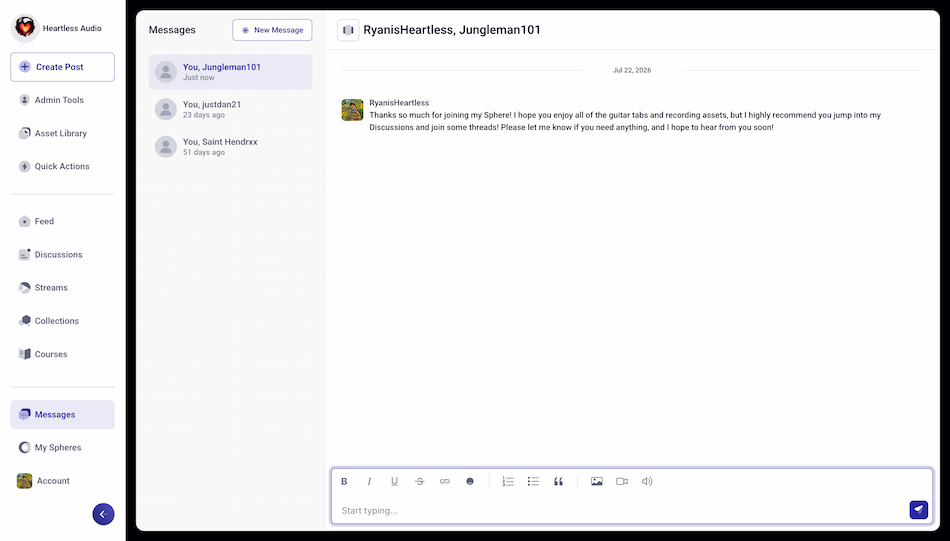
4) Send Direct Messages (But Make Them Personal)
If someone has taken the time to join your community, you need to make them feel like you actually noticed.
This is why a short welcome message can go a long way.
And it doesn’t have to be a super long conversation, either.
Even just a quick message thanking them for joining and pointing them towards a few helpful resources can make your community feel so much more personal (in a good way).
This is why I love using Sphere as the platform for my Heartless Audio community – the direct messaging feature is invaluable to me. Just a little bit of personal attention early on can lead to much stronger long-term engagement from your members.
When I started building Heartless Audio on Sphere, one thing stuck out to me fairly quickly:
I didn’t want this to become just another place where everyone only talked to me.
I wanted musicians talking to other musicians.
Sharing songs.
Giving feedback.
Helping each other solve recording problems and celebrating each other’s progress on difficult guitar riffs.
That completely changed how I thought about the onboarding process.
Instead of simply welcoming new members, I wanted to give each of them an opportunity to start conversations with the people they would be learning alongside.
Because in my mind, if the only relationship someone builds is with me, the creator, the community never becomes much more than yet another audience.
The real magic begins when members build relationships with each other.
Retention Strategies for Current Members
Getting someone to join your community is one thing, but getting them to come back every week is a whole other ball game.
The easiest way to do that is by creating consistency.
When members know there’s always something happening, checking in becomes part of their routine.
5) Create Weekly Community Rituals
One of the easiest ways to keep members coming back is by giving them something familiar to look forward to.
I’m sure you’ve heard the quote “people are creatures of habit.” When they know there’s always something happening in your community, checking back in starts to become part of their daily or weekly routine instead of something they have to actually remember to do.
This is where a recurring community ritual comes in.
Some of the healthiest communities you’ll find have recurring traditions that members can count on week in and week out.
Maybe it’s a “Pro Tip Tuesday.”
Or a “Friday Wins” discussion thread.
Monthly goal setting or recaps.
Or even a weekly “what are you working on this week?” discussion.
The specific topic isn’t nearly as important as the consistency.
Members shouldn’t have to wonder if something is happening today, they should expect it.
Over time, those recurring moments can become part of your community’s culture. Members begin looking forward to them, participating becomes second nature and they start returning. Not because they received a notification, but because checking in has become part of their routine.
6) Host Livestreams
One of the biggest advantages creator communities can have over traditional social media is that interaction goes both ways.
Instead of simply publishing content for people to consume and doom scroll, you’re creating opportunities to spend time with your members in real time.
Livestreams are a great way to really lean into that.
Instead of treating them like presentations, treat them like conversations. Think of them more as a hangout rather than a webinar.
Answer questions, invite discussion, bring members into the stream if you’re able to.
The goal isn’t to produce a super polished, perfectly scripted livestream every week.
It’s to create a shared experience that makes your members feel like they're part of something bigger than just another social media audience.
Over time, those casual conversations can help build trust and relationships, not just between you and the members, but between the members and each other. That can be exactly what keeps them coming back.
7) Run AMA Sessions
Ask Me Anything (AMA) sessions are another simple but incredibly effective way to invite participation.
Sometimes members have questions they have been waiting to ask, but didn’t feel like they were important enough to start a new discussion over.
An AMA removes that hesitation and doubt by creating a dedicated space where asking questions is literally the whole point.
Not only does this lower the barrier to participation, but it can also help members feel like they have more direct access to you as the creator. And that kind of accessibility goes a long way toward building trust and strengthening trust within your community.
And here’s something that is really easy to forget…
You really don’t need to know every answer.
In fact, some of the best conversations can happen when other members jump in to share their own experiences and offer advice, or answer the question themselves.
Sometimes you’ll discover the answer together as a community.
Those conversations are often far more valuable than simply giving someone the right answer, right away, because they reinforce the idea that your community isn’t just a place to learn from you, it’s a place to learn from each other.
8) Celebrate Member Wins
If I could recommend just one engagement strategy from this entire article, this would probably be it:
Celebrate your members!
Finished a project?
Celebrate it.
Hit a major milestone?
Celebrate it.
Landed a new client?
You guessed it… Celebrate it!
Communities become so much more engaging when people know that their progress will be recognized.
And in turn, this recognition encourages more participation.
Participation encourages real connection, and that connection is what keeps people coming back.
9) Turn One Conversation Into Value for Everyone
If you offer coaching, mentorship, or consulting, chances are you’re already creating valuable content, you just might not realize it yet.
Every conversation you have with a member is an opportunity to help dozens of others who are probably asking themselves the same exact questions.
With permission, of course, you can summarize the biggest takeaways from a coaching call and share them with the rest of your members.
You can even do the same with common questions from livestreams, open office hours, or direct messages if they’re relevant to your community.
The beauty of this approach is that you’re creating content based on the real problem your community is actually facing, rather than just guessing what they want from you next.
So instead of starting from a blank page every time you need a new post, try repurposing the conversations you’re already having.
Because not only does this save you time, but it also reinforces an important message to your members: that their questions matter, and asking them helps the entire community to learn and grow together.
10) Share Community Polls and Surveys
Sometimes the easiest way to encourage your members to get active, is to simply ask for their opinion.
Polls are quick and easy, and surprisingly effective at getting even your quietest members involved and speaking up. Not everyone is going to be comfortable with writing long discussion posts, but clicking a button to cast a vote only takes a few seconds.
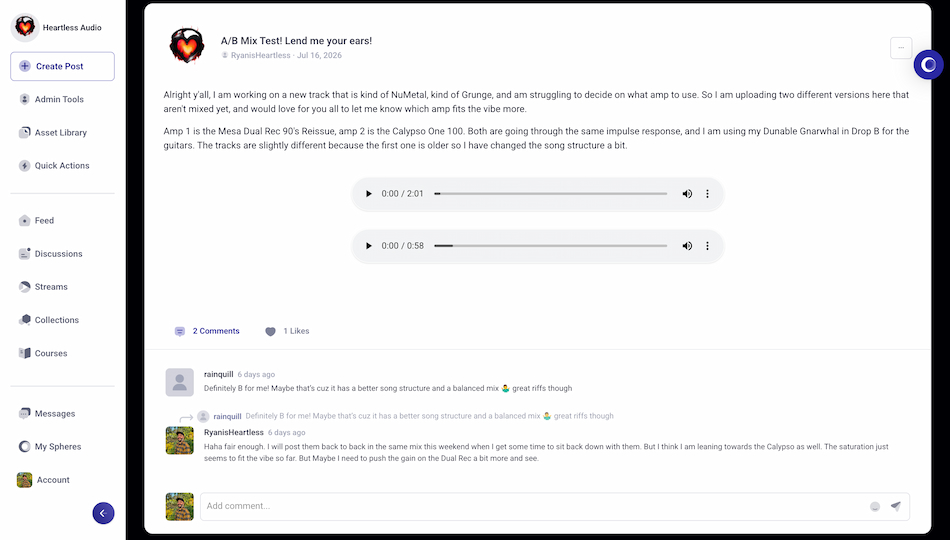
They also give your members a voice in the direction of your community.
Instead of guessing which topics to cover next, which livestream you should host, or what resource would be of value…
Just ask.
The answers can help shape your future content, products, and events better than any brainstorming session on your own ever could.
Even more importantly, acting on that feedback shows your members that their opinions actually matter.
Seeing a pattern here yet?
Because when people see their suggestions turn into new discussions, resources, or events, they become much more invested in the community because they feel like they’re actually helping to shape its future, not just consuming content.
Give Members Reasons to Participate
Returning to your community is great, sure. But plenty of people show up and stay in the background – the dreaded lurker.
What you want is people who actually participate.
There’s a 90-9-1 Rule in social psychology called Participation Inequality, which serves as a good rule of thumb for how members will engage:
- 90% percent of members are lurkers
- 9% contribute a little
- 1% are power users
These next strategies will help you to move members from quietly observing to actively contributing!
11) Run Community Challenges
Challenges can create serious momentum.
Whether it’s a weekly guitar riff writing challenge (I do these on Heartless Audio) or a monthly fitness challenge, shared goals can naturally bring people together.
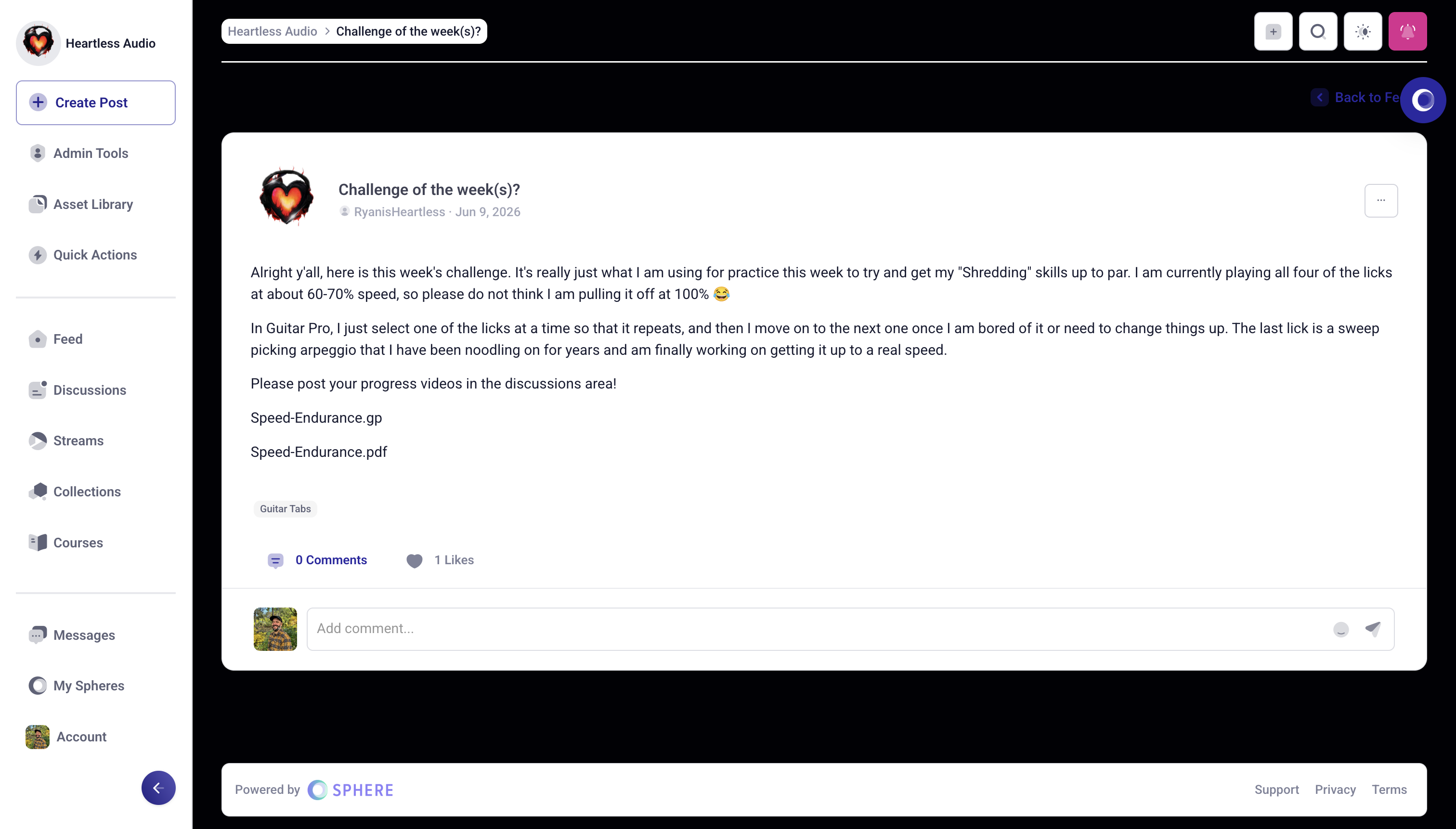
Members can encourage each other.
They share updates.
They celebrate progress.
Even people who don’t participate will usually enjoy following along to see others’ progress.
12) Reward Participation With Unlockable Content
Exclusive content can be a powerful engagement tool when used intentionally.
Instead of locking everything behind participation, you can reward members for contributing.
Maybe this means completing your onboarding unlocks additional resources.
Or participating in discussions can unlock a bonus course.
The goal isn’t to force activity, but to reward it.
13) Gamify With Leaderboards
Leaderboards can be much more effective than you might think…
Why?
Because they tap into something that’s true of almost every community: people like being recognized for contributing.
A leaderboard can give your most active and helpful members a chance to stand out, while also showing everyone else what kind of participation you and your community values. It creates a little friendly competition, encourages members to check back more often, and gives people another reason to actually stay involved.
But here’s the catch…
You have to reward the right behaviors.
You want to avoid encouraging people to post simply for the sake of posting, because trust me, people will take advantage of that.
Instead, reward thoughtful comments, helpful answers, quality discussions, and consistent participation in the community.
Quality should always beat quantity.
Otherwise, you’ll just end up encouraging and rewarding spam instead of real engagement.
14) Create Accountability Groups
Sometimes people don’t need a larger community.
What they really need is one or two people checking in on them and holding them accountable.
Think about it like having a workout partner to go to the gym with. You don’t want to let that person down, and they’ll also call you to make sure you’re awake and ready to go to this morning’s workout.
Pairing members into accountability partnerships or small groups can seriously increase participation.
People are much more likely to show up when someone else is expecting them to, or relying on them.
This can work especially well for communities focused on fitness, business, learning, or creative projects.
15) Offer Members Ownership
One of the biggest mistakes creators can make is believing they need to create every single conversation themselves.
You really don’t…
In fact, you probably shouldn't.
You want to invite members to answer questions.
To start discussions.
To welcome newcomers and share resources.
The strongest communities will eventually become places where members are able to help shape the member experience.
And that’s when a community stops depending entirely on the creator for engagement.
One realization that has really changed how I think about community is this:
Success isn’t measured by how much I post in the Heartless Audio community.
It’s measured by how often my members talk to each other.
When I see musicians giving feedback on someone else’s mix, recommending gear, or helping another member out of a creative rut, that’s when I know the community is doing exactly what I had hoped it would.
Because at that point, the value isn’t coming from me alone anymore.
It’s coming from the people who make up my community.
And that is a much healthier and sustainable place for me to build from.
Common Community Engagement Mistakes
Before we wrap up, I really want to cover a few mistakes creators can make that will quietly kill community engagement.
Only Posting Announcements
If every post is an announcement, then what was the point of joining rather than just seeing it on Instagram or Facebook?
Communities should feel like conversations, not bulletin boards.
Rewarding Quantity Over Quality
A member posting 50 low-effort comments isn’t the same as saying something meaningful.
Design your incentives around real, helpful participation, not just activity for activity’s sake.
Creating Every Conversation Yourself
You don’t have to carry the whole community on your shoulders.
Some of the best discussions happen when members answer each other’s questions or spark up a conversation in a thread before you ever even see them.
Just make sure to encourage that when it happens.
Giving Members No Reason to Return
If every day inside your community feels exactly the same, people will eventually stop checking in.
Recurring events, rituals, community challenges, and discussions all give members something to look forward to.
Online Communities Engagement Strategies Wrap-Up
Thriving online communities are built on engagement.
So, here’s my challenge for you:
Don’t try to implement all 15 of these strategies today.
Pick just one.
That’s it.
Maybe you create a better onboarding checklist.
Maybe you start celebrating your members’ wins every Friday.
Maybe you finally schedule that monthly AMA you’ve been thinking about for months.
Small improvements repeated consistently almost always work better than trying to completely overhaul your entire community overnight.
That’s definitely been my experience while building Heartless Audio over on Sphere.
As my community continues to grow, I’m constantly learning, adjusting, and paying attention to what actually helps my members connect with each other.
Because at the end of the day, that is truly what community is all about, right?
Not posting more.
Not chasing engagement metrics for clout.
Helping people to feel welcome, connected, and valued.
If you can do that consistently, engagement tends to take care of itself. And regular engagement is what makes community monetization possible – which means you can build your community into something great without having to pick up side hustles or stay at a 9-to-5 job you hate.
And remember, if you’re looking for a place to host your community, Sphere gives creators a dedicated place to welcome members, host conversations, run live sessions, and turn passive followers into an active free or paid community.
If you haven’t yet taken the leap to make your own online community, be sure to check out Sphere and get started for free today.
Good luck, and I will see you in Sphere!
Frequently Asked Questions
How do I increase engagement in an online community?
Start by making it as easy as possible for members to participate. Welcome new members in direct messages (DMs), create recurring discussions, celebrate wins, ask thoughtful questions, and give people opportunities to help each other. Don’t just simply post more – give members a reason to join the conversation.
Why do online communities lose engagement?
Communities can often lose engagement because members don’t have a reason to participate, let alone log back in. If every day feels the same, conversations slow down or cease completely. Regular recurring events, community rituals, recognition, and opportunities for members to contribute can help keep up engagement.
How often should I post in my community?
Consistency matters more than volume here. Posting one thoughtful discussion each week is going to be more effective than publishing multiple announcements every day. This isn’t a social media feed like Instagram or TikTok! Focus on creating conversations instead of just content.
What types of posts get the most engagement?
Questions, member spotlights, community challenges, polls, and celebration posts tend to perform well because they all invite participation. Posts that encourage your members to share their own experiences will also usually create more meaningful conversations than a simple one-way announcement would.
How long does it take to build an engaged online community?
Every community will grow at its own pace, and strong engagement rarely happens overnight. Just like any relationship, building trust takes time. So just focus on consistently creating opportunities for your members to connect with you and each other, and the engagement will come with time.