
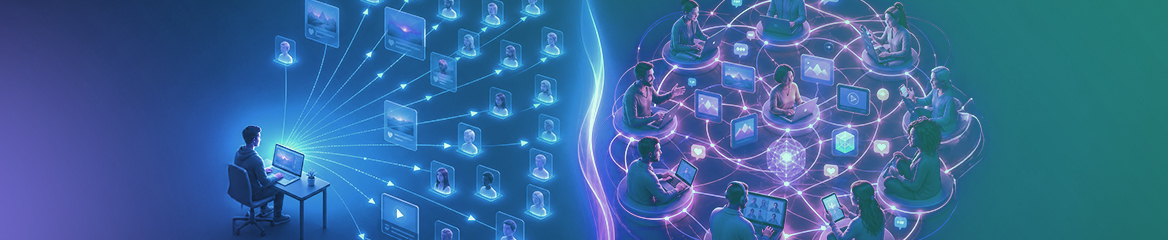

Is an audience the same thing as a community?
Not even close!
An audience can be great for discovery, reach, and getting your work in front of new people. But it’s still primarily a one-way channel: you publish something, your audience consumes that content, and a small percentage of them may like it, share it, or leave a comment.
A community is much more of a give-and-take relationship among a larger group. Members don’t simply follow you – they participate with you, talk to each other, share experiences, and build relationships around a common interest, problem, goal, or you as the community owner.
And to be honest with you, most creators actually need both an audience and a community!
Your audience is the group who discovers you, while your community is the place for your “true fans” to land, participate, and (hopefully) become paying customers.
So, in this article, I’ll break down the key differences between a social media audience and an online community, then help you answer the following question: Which one makes the most sense for your creator business – and how do you turn passive followers into active members?
Let’s talk about it!
Audience vs. Community: What’s the Difference?
The key difference between an audience and a community comes down to participation, not size.
An audience is primarily built around one-to-many communication where the creator publishes, and everyone else watches, listens, or reads.
A community, however, creates many relationships…
Members communicate with the owner of the community, of course, but they also interact with each other. They ask questions, share feedback, solve problems, and contribute value of their own to the group.
That’s why a creator with 50,000 followers might not have any sort of a real community, while another creator with what seems like a meager 200 community members can have an incredibly strong creator business and actually monetize their online community.
Because an audience consumes, while a community participates.
What is an Audience?
An audience is a group of people who consume your work output.
You may already have an audience built through platforms like:
- YouTube
- TikTok
- Twitter/X
- A podcast
- A blog
- An email newsletter
And audience marketing is essential because it helps new people find you! Every creator should build an audience, and nearly every creator business begins there.
The relationship, however, is still mostly one-way.
You publish a video, and people watch it.
You post a photo, and people see it as they scroll (and hopefully, like or comment on it).
There may be some small amount of communication happening,, but the content still starts with you and flows outward.
For a massive celebrity or influencer, that’s honestly more than enough!
Someone like Kylie Jenner can easily publish content for her 382 million Instagram followers and generate insane attention, product sales, and brand opportunities without any official online community.

But the reality is, most of us are not Kylie Jenner…
The typical creator will never reach enough people to consistently build a sustainable business from passive attention alone.
This Ain’t Your Grandpa’s Social Media Audience
The nature of an audience on social media has also changed drastically in recent years!
Followers used to literally follow you…
They chose to see your posts and the old-style chronological feeds gave followers a reasonable chance of actually seeing what you published.
But thanks to TikTok, Instagram, and so-called “interest-based algorithms,” that whole game has changed.
Now, the platform decides which posts appear in front of each user. That means someone can follow you, enjoy your work, and still go weeks without seeing anything you’ve posted.
Unfortunately, this has had an effect: modern audiences are much more passive than followers were in the past. So you may technically have thousands of followers, but you can’t reliably reach even a fraction of them unless the algorithm says otherwise.
To be clear: your social following is valuable… but you do not own the relationship!
You are playing the Attention Game on someone else’s platform (find out more in our guide about what an online community is).
What Is a Community?
A community can be generalized as a group of people brought together around a shared purpose, interest, identity, hobby, or problem.
Unlike an audience, community members aren’t there just to consume content.
They participate.
They start discussions.
They answer questions.
They offer feedback, support, and accountability.
And most importantly, relationships take shape beyond the creator.
That is usually the moment a group really starts to feel like a community. Conversations continue even when you’re not there to start them, and the members themselves become part of the community’s value.
A community also creates opportunities for great access to you and interaction through things like:
- Community discussions
- Group calls
- Open Office Hours
- AMA’s
- Coaching
- Direct support
This increased access can require more time and energy from you, so keep that in mind. It isn’t automatically easier than just building an audience.
But people are also much more likely to pay a premium for access, support, and true interaction than for just another social media feed.
Audience vs. Community: The Key Differences
Let’s drive home a few key differences between a social media audience and an online community:
Communication
An audience is almost always one-to-many, while a community is usually many-to-many.
With an audience, the creator broadcasts and their followers react. In a community, members actively participate in ongoing conversations with the creator and with each other.
Sometimes, when membership reaches a critical mass, the many-to-many communication in a community doesn’t even require the creator anymore!
Ownership
Social media platforms like Instagram own the connection between you and your followers.
They control the algorithm, the feed, the features, and how often your content gets seen. This means you’re forced to always play their game and hope the “algorithm gods” keep you in their good graces.
But a dedicated community platform gives you a more direct relationship with your members. This means you’re no longer committing the fate of your entire business on an algorithm that decides whether the people who literally asked to hear from you will actually hear from you!
Remember this: social media helps you earn attention. But community building helps you to deepen and actually retain that attention.
Engagement
Audience engagement is usually measured through likes, comments, shares, views, and watch time – whereas community engagement can look more like discussions being replied to, accountability, collaboration, feedback, support, and ongoing relationships.
Sure, a comment under a video on Instagram or TikTok can be valuable…
But it is rarely the same thing as a member asking a detailed question, getting useful advice or feedback, and then helping another member with that same problem later on.
Value Creation
The value of an audience tends to come from your content and its scale.
But the value of a community comes from its people and its relationships.
To put this more crudely, one active member of your own paid community may be worth 100 or even 1,000 times more to your business than one passive view on Instagram, TikTok, or YouTube.
Just think about the differences between a single ad impression and a real, paying customer who joins your membership, purchases a course, or works with you through coaching.
You would need a HUGE volume of passive views to get anywhere close to the value of a relatively small group of engaged members.
A community can truly magnify the value of each relationship in your orbit!
Why Most Creators Need Both an Audience and a Community
Now, as I said earlier, none of this means social media is inherently bad or that creators should abandon their audience.
Quite the opposite, in fact!
You still need the discovery boost that a social media audience represents.
Your audience is where new people come in, and your community is what keeps them around.
Content attracts… Community retains.
In business-speak, content and community aren’t competitors, just different stages of the same customer journey.
Your public content helps your target audience discover your work without making a commitment. If or when they continue watching, reading, or listening, you start to accrue trust with them.
Then, a community gives those most engaged audience members a clear next step.
And that is the difference between the Attention Game and the Ownership Game.
Social platforms give you the reach, but a dedicated community gives you the space to build deeper relationships without depending entirely on the algorithmic anomaly of virality.
My Experience Building the Heartless Audio Community On Sphere
I built my audience as RyanisHeartless on the socials long before I built Heartless Audio on Sphere.
YouTube, Instagram, and TikTok helped other musicians discover my work, which is why those platforms still play a HUGE role in what I do – they allow me to reach people who might never have heard of me otherwise!
I would even go so far as to say that without those social platforms, I probably wouldn’t have a single member on my Sphere other than my wife…
Heartless Audio on Sphere gave the most engaged people in my audience somewhere to land.
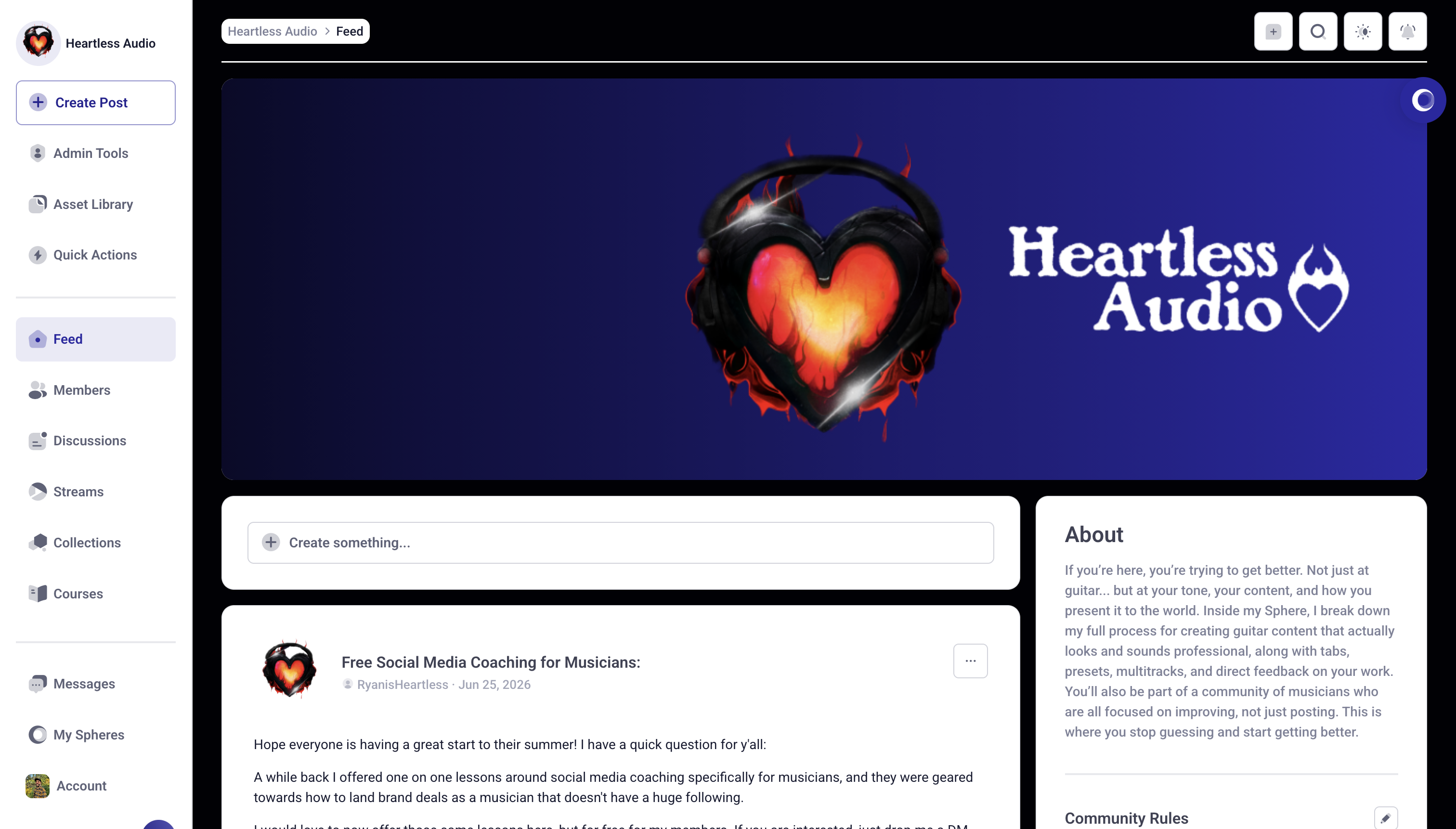
And inside my community, members can ask questions, share their own riffs and recordings, jump into discussions, access exclusive guitar tabs and DAW templates, and most importantly, connect with fellow musicians.
The conversation no longer has to end when my latest video does!
When Should You Build an Audience vs. a Community?
These days, most creators should start by building an audience first – just being real with you!
Public-facing social media content gives people an easy way to discover your work, understand who you are and what you’re about, as well as whether or not to trust you.
Then, a community will make more sense once some of those people want more.
So you might be ready when:
- People keep asking you the same questions
- Followers want more access, interactions, resources, or support
- People are helping each other and answering questions in your comments
- You have a growing number of repeat or regular viewers
- Your content is consistently centered around a clear interest, problem, or goal
- You want to build a recurring revenue stream through a membership, courses, or coaching
If any of that sounds like where you’re at right now, then we’ve got a great guide on how to build an online community that you can check out!
But if I were starting over today, I would focus much more heavily on building an audience while visibility was my biggest problem – whereas I would focus more on a community once retention, participation, relationship-building, and monetization became bigger opportunities in my business.
And for established creators, the answer is actually to do both.
That’s how I use Heartless Audio today.
Social media and YouTube help other musicians find me. And then Heartless Audio on Sphere gives them a place to land when they want something more than just another 30-second guitar riff to scroll by.
When they want to learn how I make my guitar tones, write my riffs, or even film my videos for social media and YouTube, I’ve built the community that powers it all!
Once they’re in, they realize they can also talk to my other members, some of whom are lightyears ahead of me on guitar.
So the goal is not to move everyone off of social media…
The goal is to give the right people that meaningful next step!
Frequently Asked Questions
Is an audience the same as a community?
No. An audience primarily consumes content through one-to-many communication, while a community participates in many-to-many conversations, experiences, and relationships.
Do I need an audience before building a community?
Not necessarily, but it helps immensely. An existing audience gives you a group of people who already understand your work and may be interested in deeper participation with you.
Can you make money with a small online community?
Absolutely. A small group of active members can actually be more valuable than a much larger group of passive followers on social media. Communities can generate revenue through paid membership, online course sales, coaching, premium resources, and direct support.
Can brands build communities too?
You bet! A brand community can bring customers together around a company, product, lifestyle, or shared identity.
Think of Apple, LEGO, Peloton, and CrossFit. These are all examples of brands that have inspired strong (verging on cult-like) communities around what they sell, and what participating in that brand truly represents.
And a customer community can also be a huge improvement to support, education, feedback, retention, and word of mouth for a company. The strongest community-driven brands tend not to just create customers… They create advocates who want to help that group grow and thrive.
Audience vs. Community Wrap-Up: You Don’t Have to Choose
Audience vs. community was never really an either-or type of question, which is something most creators keep getting wrong.
The modern creator usually needs both at the same time. Their audience will help people discover them, and their community gives those people a reason to stick around so that the creator isn’t just another part of a doom-scrolling session on someone’s lunch break.
So if you’re already publishing content consistently and finding your audience, your next step probably shouldn’t be to double down on creating even more content…
It should be to give the people who already trust you a unique place to land for an even deeper relationship.
Again, this is exactly why I built Heartless Audio on Sphere, and why I believe creators should eventually think beyond their followers and put real thought and effort into building their own online community.
So if that sounds like a goal you can get behind, create your Sphere and start building a space you own, where your audience can actually become something meaningful.
I hope this was helpful, and I can’t wait to see you all inside Sphere!