
![What is an Online Community? [The Ultimate Guide for Creators and Brands]](/images/post/what-is-an-online-community.jpg)

In a world where we spend more time online than ever before, we somehow feel less connected than ever. This is one of many reasons why online communities have exploded in popularity over the past few years!
Creators, coaches, brands, educators, musicians, and businesses are all building communities instead of relying solely on social media as an income source. Anyone trying to make a living from social media alone knows the anxiety and instability all too well. There’s a lot of volatility in earning an income from social platforms.
But what even is an online community? Let’s talk about it.
What is an Online Community?
You can think of an online community as a digital gathering place of sorts, where people who care about the same topic, hobby, goal, or purpose can regularly interact, build relationships, and learn from each other.
Every successful online creator community tends to center around a few defining traits:
Shared Purpose:
- Its members have something in common – it isn’t just a random gathering.
- Some examples can be fitness goals, business growth, guitar recording, parenting, or gaming.
Ongoing Interaction:
- Members aren’t just consuming content like on traditional social media platforms.
- Community members actively participate instead of just lurking or passively scrolling.
Member Relationships:
- Members are able to connect with each other, not just the creator.
Sense of Belonging:
- People feel like they’re part of something, rather than yet another number in a follower count.
Audience vs. Community Members
Many of us are used to the way an audience works in content creation, where communication is mostly one-way: creator → followers.
In a creator community, however, you will notice that multi-directional communication is what makes the online community valuable to creators and members alike. The communication looks more like: creator ↔ members ↔ members.
An easy example of this is how the members interact in my own online community, Heartless Audio.
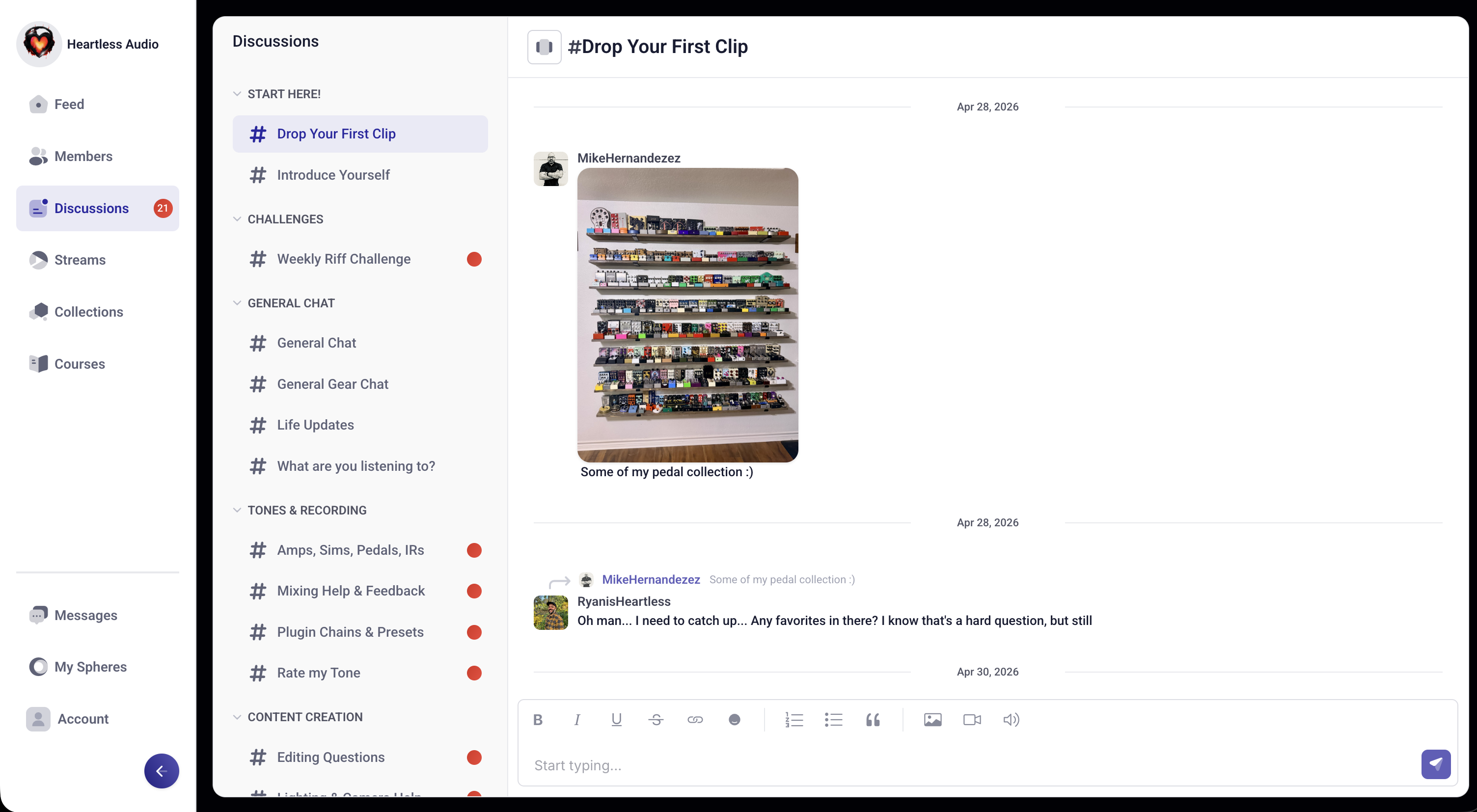
Not only can they talk to me via direct messages and comments on my feed posts, but they can also have entire conversations inside my discussions area. This is one of my favorite aspects of having a creator community on the Sphere platform, because discussions and conversations are where the real magic happens.
Genuine interaction with myself and other members is what provides a sense of belonging, instead of just being another transaction.
This is why a following of 100,000 YouTube subscribers is still just an audience, whereas having 100 active, paying community members is a thriving online community.
How Online Communities Work
An online community works by bringing people together around something they deeply care about – enough to keep showing up for it day after day, week after week!
That “something” can be a shared interest, a goal, an identity, or even a common problem or pain point they are trying to solve.
For example, someone might join an online community because they want to:
- Grow or build their business
- Get in shape for the first time
- Improve their photography skills
- Connect with other parents
- Find people who understand their niche hobby
- Get better at content creation
Whatever the general topic ends up being, that’s what gets people in the door, but as we talked about earlier, the interaction is what keeps them around!
That’s the biggest difference between a creator community and just another course or content transaction.
A course provides content for an audience to consume, but an online community provides a place for members to belong!
Members Join Around a Common Interest, Goal, or Identity
Most online communities tend to start with one central idea.
This can be super broad at first, but the strongest and most successful communities usually become more specific over time.
For instance, a “general fitness” community might work, but a “Strength Training for Women Over 50” is so much clearer. A “music” community could work, but a “Guitar Recording Community for Independent Musicians” gives members a much more compelling reason to join.
It’s this specificity that also makes the community, and what it offers, easy to understand at a glance. Potential members will make a split-second decision about whether to join your thing, so you want it to be a no-brainer for the right person to say yes.
Here are the three questions you should immediately answer on your community page:
1. Is this community for me?
2. What will I get out of joining?
3. Why should I join now?
If the answers to those questions are obviously “Yes!”, then you will have a much stronger community foundation from the start.
Discussion and Content Sharing
Once members start joining, a community needs activities to keep them engaged.
Activity can come in many forms, but the most common examples include:
- Discussion posts
- Comments
- Videos
- Livestreams
- Lessons
- Polls
- Q&As
- Community events
- Member updates
In some communities, the creator or brand tends to lead most of the conversation. This can work, but isn’t always the best way to build ongoing engagement.
The strongest communities have members interact and start creating value for each other, instead of waiting only for the creator or comomunity owner to do so.
This is when the community really becomes more than just a product or transaction. It becomes a living, breathing space where everyone contributes their own experiences and advice.
And for creators? This is a huge shift…
Because instead of constantly feeling like you need to post more and more content out into the void, your community can become the place where your most loyal audience members are actively shaping the conversation with you.
Relationship Building
People don’t just join a community (and spend money) because they want information. They join because they want connection.
They want guidance, accountability, feedback, and access to people like them who understand where they are coming from.
The internet already has unlimited information at our fingertips, just about anything is a Google search away.
What people need, is context.
They need help applying that information to their own life, their business, hobby, or situation.
In healthy online communities, members can ask questions and share progress, get feedback, and learn from people who are either on the same path as them, slightly ahead, or have actually done the exact thing they are trying to do.
This creates a type of relationship that is so much harder to build through social media alone.
Moderation and Governance
Every online community needs some form of moderation.
This doesn’t mean that your community needs to be super strict or micro-managed, but it does need clear expectations set from the start.
Without moderation, online communities can quickly get noisy, spammy, confusing, or even toxic.
Anyone who has used a poorly moderated Slack channel will know exactly what I mean there…
Thankfully, good moderation can help protect the experience for members and the creator alike.
This might include rules around self promotion, keeping communication respectful, support requests or behavior reporting, and types of content allowed in the community.
For creators and brands, moderation is not just preventing bad behavior. It’s about creating a culture that you want your members to experience within your community.
Community Culture and Norms
Whether you mean to build one or not, every online community develops a ‘culture’ of its own.
Some communities can feel supportive and encouraging.
Some feel competitive.
Some feel chaotic.
Some feel like they’re led by experts, and others can feel like they’re 100% member-led.
The best community leaders tend to understand that culture isn’t created only by what they say. It’s actually created by what they reward, what they allow, and what they model for their members.
So if you want members to post their wins, you need to celebrate wins.
If you want members to ask thought-provoking questions, you need to answer thoughtfully. (Don’t be afraid to record a quick Loom for even more of a personalized touch.)
If you want members to interact and support each other, you need to make that behavior as visible as you can.
Sure, technology is technically what what enables an online community to exist, but the people are what give it real value at the end of the day!
6 Types of Online Communities
Not all online communities serve the same purpose, and they’re certainly not all built the same.
Some are built for customer support in the shape of online forums for a brand, particularly software. Some are built for learning and education. Others are built around networking, while many are built around a creator’s content, personality, or expertise on a subject.
Understanding the different types of online communities out there can help you figure out what kind of community you might want to build!
Let's explore some of the most common types, shall we?
1) Brand Communities
Brand communities are built around a company, product, or brand.
Some popular examples include Sephora, Lego, Peloton, and many other companies with a highly engaged customer base.
These communities tend to work because their members don’t just use the product… They identify with the brand in some way, and it becomes part of their lifestyle!
The strongest brand communities turn customers into fans, and fans into brand advocates.
This is super powerful because people are much more likely to trust another customer’s opinion or review than a traditional ad on YouTube or Instagram. When members actively share their experiences, answer questions, post results, or show how they use the brand’s product, the brand gets a level of authenticity and social proof that it never would with just another ad.
The key takeaway here?
Great brand communities make customers feel like part of the brand, not just a customer. If you have a business, a brand community could be a game-changer.
2) Customer Communities
Customer communities are usually created around support, education, and product success.
These are very common for software companies, tech products, and online tools, as well as service-based businesses – for example, the personal finance software Quicken has a lively customer discussion community at community.quicken.com.
In these communities, instead of every customer question going directly to a support team, members will often help each other solve common issues.
These can include:
- Troubleshooting
- Product tips
- Feature requests
- Best practices and use cases
- Tutorials and education
- Basic support
For businesses, this type of community can greatly reduce the burden of support, meaning fewer labor hours spent addressing common questions.
On the customer side of things, it can create a better experience because they aren’t always waiting on a company representative who could be in an entirely different time zone to answer a simple question or learn how to do a specific task.
So the best customer communities aren’t just a crowd-sourced help desk. They become a place where customers cam learn from each other how to get more from the product or service.
3) Creator Communities
Creator communities are one of the biggest opportunities in the creator economy right now.
A creator community is built around a creator’s audience (remember audiences vs. members from earlier?), expertise, content, personality, or even a transformation they help their members achieve.
Most creator communities include at least some of the following:
- Memberships
- Coaching
- Exclusive content
- Behind-the-scenes posts
- Livestreams
- Courses
- Community events
- Direct access to the creator
- Members-only discussions
For the creator, the biggest benefit is that their community creates a deeper relationship with the people who actually care about their work.
You know, the people that followed them for a reason on traditional social media platforms, but then the algorithms decided not to show their content to them anymore?
That’s because social media is great for discovery, but rarely great for depth or meaningful interactions.
For example, a musician like myself might create a community around home recording. A fitness creator could build one around strength training or power lifting. A business coach might build one around helping freelancers find their first clients.
The key here is that the community really needs to have a reason to exist beyond “come in and hang out with me."
That path can work if you already have a strong personal brand, but for most creators, the best approach is to build their community around a clear outcome and shared interest.
4) Professional Communities
Most professional communities will be built around member’s shared careers, industries, or even networking (have you ever used LinkedIn?).
These might be communities made of marketers, designers, writers, salespeople… Just about any profession you can think of.
People tend to join these communities because they want to grow their professional skills, find opportunities (networking), learn from their peers, and stay connected and in tune to what is happening in their industry.
The strongest professional communities help their members:
- Find a job
- Meet collaborators
- Get critical feedback
- Share resources
- Stay up to date on the industry
- Build authority
- Learn from those that are ahead in their field
These communities thrive when their members feel like they are actually gaining access to the conversations and relationships they would not – or could not – find elsewhere.
5) Interest-Based Communities
An interest-based community is usually built around shared hobbies, passions, or lifestyle interests.
This can include communities for gaming, photography, fitness, camping, parenting, cars, music… the sky’s the limit here.
These communities can attract large amounts of members because people naturally want to connect with others who care about the same things they do. It’s the same reason clubs exist, right?
Sometimes, the value is educational.
Other times, the value is just being around people who “get it” or get you.
Think of the guitar player that wants to talk to other guitar players, or a new parent who needs advice from other parents.
Even a person restoring an old truck wants to find other people who understand the exact engine issue they’re dealing with in the moment.
That is the magic of interest-based communities: turning a niche interest into a shared experience.
6) Learning Communities
Learning communities will often be built around education, growth, and transformation, or a combination of the three.
These are very common for online courses, cohort programs, masterminds, coaching groups, and skill-based memberships.
A differentiator for learning communities, though, is that members aren’t just consuming lessons and signing out. They are moving towards a real goal, together.
That goal could be:
- Launching your first business
- Learning a new skill
- Improving your health naturally
- Building a social media content strategy for YouTube
- Writing and recording music
- Passing a certification
Learning communities can be powerful because they add a sense of accountability and interaction to what would usually be a passive educational experience.
Think of it this way: a course by itself can be very helpful, and might even offer all the technical knowledge you need.
But a course with a community around it can help members ask questions, share progress, get unstuck, and – I can’t stress this next one enough – stay motivated!
Consistency is often the difference between just buying information and actually getting the results you want and need.
Why Online Communities Matter
Online communities matter more than you might think… They create value for both the people who join them, as much as for the people who build them.
For members, a community might provide support, connection, learning, accountability, and most importantly, belonging.
For creators and businesses, building a community can create brand loyalty, a customer feedback loop, fan retention, recurring revenue streams, and long-term stability in an ever-unstable social media climate.
This is especially important in 2026, as we all know that attention is harder than ever to earn when you need to “hook them in the first 3 seconds.”
People are overwhelmed with content these days.
They don’t want just another feed to doom-scroll…
They want a place that feels useful, relevant, and connected to their life and goals.
Why Do Online Communities Matter for Individual Members?
With individual members, the value of an online community can often come down to one factor:
The member isn’t alone.
They don’t have to figure everything out by themselves, and that might sound like a simple reason, but this is a huge deal – especially on a cold, lonely place like the entire internet.
Most people are trying to solve specific problems, learn skills, or reach a goal with little to no support from the outside world. They might watch videos on YouTube, read blog posts, listen to podcasts, or search Reddit threads, but that is simply not the same as being belonging to an active community where they can ask questions and get feedback in the moment.
A great online community gives its members access to people like them, who understand their situation better than anyone else.
This not only can help them learn faster and make better decisions, but also stay motivated for longer – a factor that cannot be stressed enough!
Learning and Growth
Communities can seriously speed up the learning process, because members are exposed to real questions, real examples, and real conversations with real people.
Instead of just learning from polished one size fits all content, they get to see how other people think through the same problems, and that kind of context can be incredibly valuable.
Networking
Online communities can also make it much easier to meet new people in a world where we all work at least 40 hours a week.
This obviously matters for professionals, but also for creators, business owners, students, and anyone trying to make progress in a specific area.
The right connection can instantly lead to a game-changing collaboration, a job interview, a new client, even a new lifelong friendship.
Support
Good communities can also provide support when their members feel stuck in life.
Sometimes, people just need to know that they aren’t the only one dealing with a specific problem.
That sense of shared experiences is one of the most underrated parts of building a community.
Belonging
Now we get into the sticky parts, because belonging is truly the deeper layer here.
People want to feel like they are actually part of something bigger than themselves.
This is why online communities can be so much more meaningful than social media followings.
Because a follower count might make a creator look "successful” – but a real, thriving community makes its members feel seen? Priceless!
Why Do Online Communities Matter for Businesses and Brands?
When it comes to businesses and brands, online communities can be a serious competitive advantage.
A company with a strong community isn’t just selling to its customers – it’s building real relationships with them!
This creates all kinds of long-term value for the company, from customer retention to brand advocacy.
Customer Retention
People are much more likely to stick around when they feel connected to what they’re buying.
If a customer only sees your product as a transaction, it’s easy for them to pick up and leave.
But if they also feel connected to the brand, the mission, the team, or even other customers, they have so many more reasons to stay.
Loyalty
These days, loyalty isn’t just built through one good post, or one good product offer.
It’s built over time, brick by brick.
Communities give businesses and brands a way to show up consistently for the people who care most about their products and services.
User-Generated Content (UGC)
Online communities can also inspire the creation of user-generated content.
Members may post wins, testimonials, questions, examples, tutorials, or feedback. Think of any review you have searched for on YouTube for hundreds of examples of this.
That content can easily make the community more valuable while also giving the brand insight into what their customers actually care about.
Customer Feedback and Market Research
One of the most useful aspects of building an online community is getting direct feedback.
Instead of guessing what your audience or customers want, you can just see what they’re asking for.
What questions keep coming up?
What problems are they mentioning over and over again?
Are there any resources the members keep asking for?
This is the kind of instant feedback that can shape content, products, and services in ways that a formal focus group never could.
Reduced Support Burden
We hit on this a bit earlier, but in a customer-focused community, the members can often help each other solve an issue before someone from the company even knows about it.
This can seriously reduce the pressure on a customer support team while also helping the member to get an answer faster.
Brand Advocacy
When someone feels connected to a community, they are much more likely to talk about it.
This can lead to personal referrals (affiliate programs, anyone?), testimonials, word of mouth growth, and strong brand advocacy.
People don’t just promote things that they pay for, can you imagine being an advocate for paying your traffic ticket?
People like to promote things they actually feel like a part of.
6 Benefits of an Online Community
There are so many reasons to build an online community today, but let's take a look at a few benefits that stand out.
1) Increased Engagement
Online communities can create more meaningful engagement with their members than traditional social media alone.
On social media platforms, engagement might mean a like, a quick comment, or (hopefully) a share.
But in a community, engagement can mean members asking real questions, joining in on discussions, attending live events, sharing their wins, giving feedback, and helping other members.
That’s a much deeper level of participation or engagement than traditional platforms can foster.
For creators, this matters because engagement isn’t just about vanity metrics – it’s about building real relationships with the people who are most invested in their work.
2) Knowledge Sharing
A strong online community lets knowledge flow in multiple directions.
The creator or brand can share their expertise, but members can likewise share their own.
This creates a much richer environment, because instead of one person needing to have every answer, the community becomes a shared resource for the good of the group.
This is even more valuable in niche communities where the members may have vastly different experiences, tools, backgrounds, or unique perspectives.
3) Stronger Relationships
Relationships are one of the biggest advantages of an online community.
Social media can help you be discovered, but a community can help people get to know you.
This is a massive difference…
When members have an ongoing conversation you, and with each other, trust starts to build.
And trust, is what drives long term value and retention.
People are more likely to stay subscribed, pay for future offers, attention events and refer friends when they feel like they have a real relationship with the community.
4) Faster Problem Solving
Communities are great at solving problems because members can learn from each other and ask questions in real time.
Instead of searching endlessly for (likely A.I.-powered) answers on Google, a member can ask a specific question and get answers from people who have been dealing with the same challenge.
This is immensely useful in communities built around technical topics like software, business growth, creative skills, or education.
One solid answer from the right person can save someone else hours of frustration.
5) Improved Customer Experience
For businesses, communities can improve the overall customer experience ten-fold.
Members will feel more supported because they aren’t limited to one-way (chatbot) communication with the company. They can ask questions, get updates, learn from other customers, and feel more connected as a result.
And this is just as important for creators, too.
A creator community can make your audience feel like they are getting a more personal experience than they could ever get from just following you on Instagram.
6) Organic Growth Through Referral
Strong communities often grow through word of mouth.
When a member gets some sort of value, they naturally want to talk about it.
This might look like inviting their friend, sharing a post, mentioning the community in a video, or recommending it to someone with the same problem they had.
This type of growth is so powerful because it is based on trust.
A paid ad can introduce someone to your community, for sure… But a recommendation from a friend can make them 100X more likely to actually join!
Examples of Successful Online Communities
There are online communities everywhere, but let's take a look at a few successful examples to make it a bit easier to understand why different community models work.
Okay, I definitely took the obvious choice here, but for good reason. Reddit is easily one of the clearest examples of interest based online communities.
Instead of being one giant conversation, Reddit is made up of countless smaller communities called Subreddits.
There are subreddits for super broad topics like fitness, music, business, and technology, but there are also extremely specific subreddits for niche hobbies, local cities, career paths, and personal interests.
So who is it for?
Reddit is for people who want to find discussions around specific interests, questions, or communities.
Why does it work?
Reddit encourages specificity. People can find communities around almost anything they can think of, no matter how niche.
So the key takeaway, is that the more specific the community is, the easier it is for members to feel like they are in the right place.
Discord Communities
Although Discord may have started heavily in the gaming community, it has become a very popular home for all kinds of creators, hobbyists, and interest based communities.
Discord is made for creators, gamers, hobby groups, and communities that want fast, real-time communication in their groups.
Real time access in Discord can make a community feel alive, but it also needs structure so members don’t get overwhelmed.
Facebook Groups
Facebook groups are probably one of the most familiar examples of online communities.
They are used for local neighborhood groups, parenting groups, hobby communities, businesses, support groups, and countless other specific interests as well.
These are for people who want a simple, familiar place to join in on group discussions. My neighborhood even has one!
Convenience matters here, but creators and businesses should also consider how much control they actually have when building on a social platform they don’t own.
Sphere Communities
Sphere is a creator community platform built for creators who want to bring their audience, content, memberships, courses, and community together all in one place.
This one I can speak to on a personal level, as I launched my own Sphere, Heartless Audio, earlier this year.
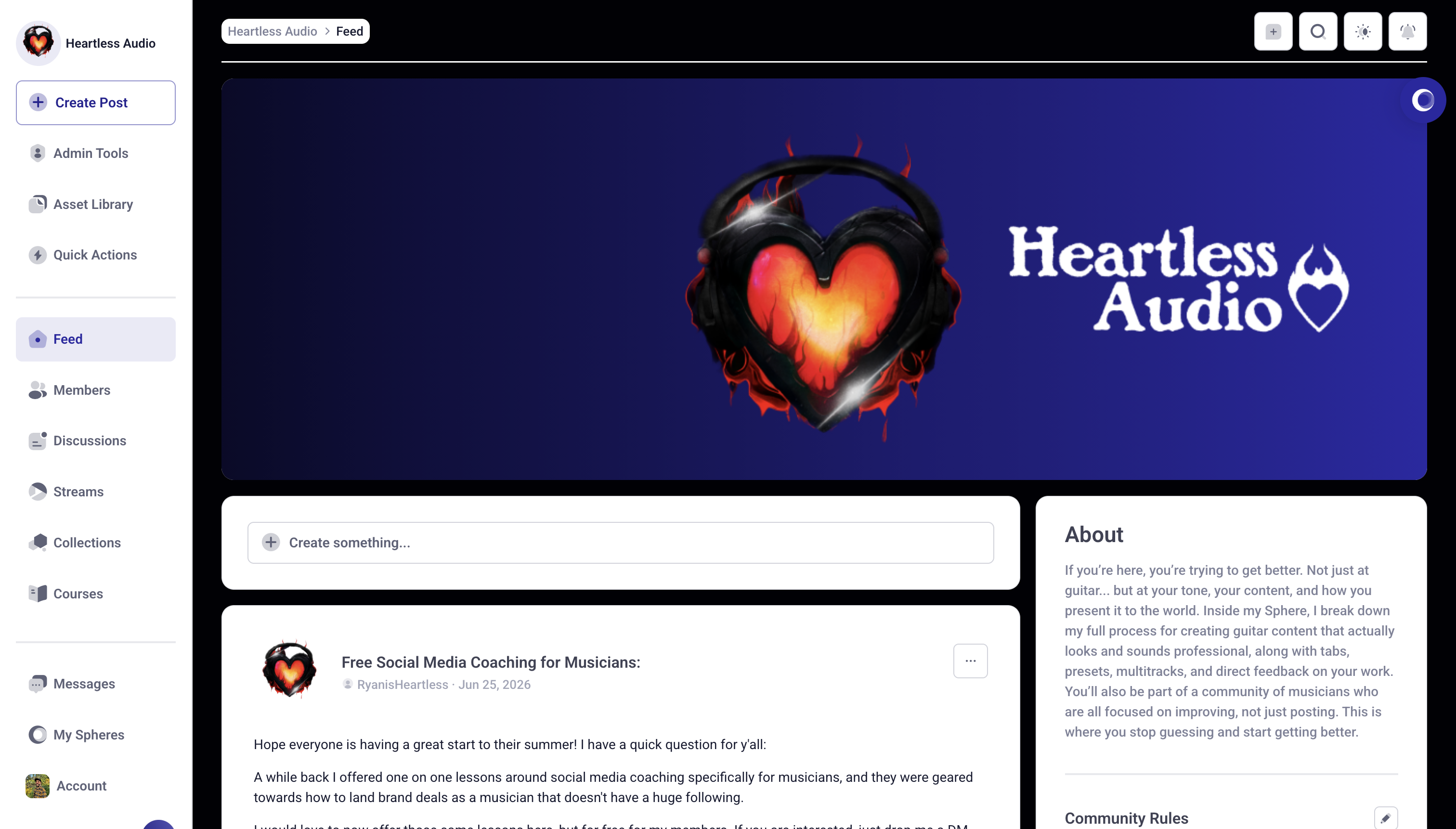
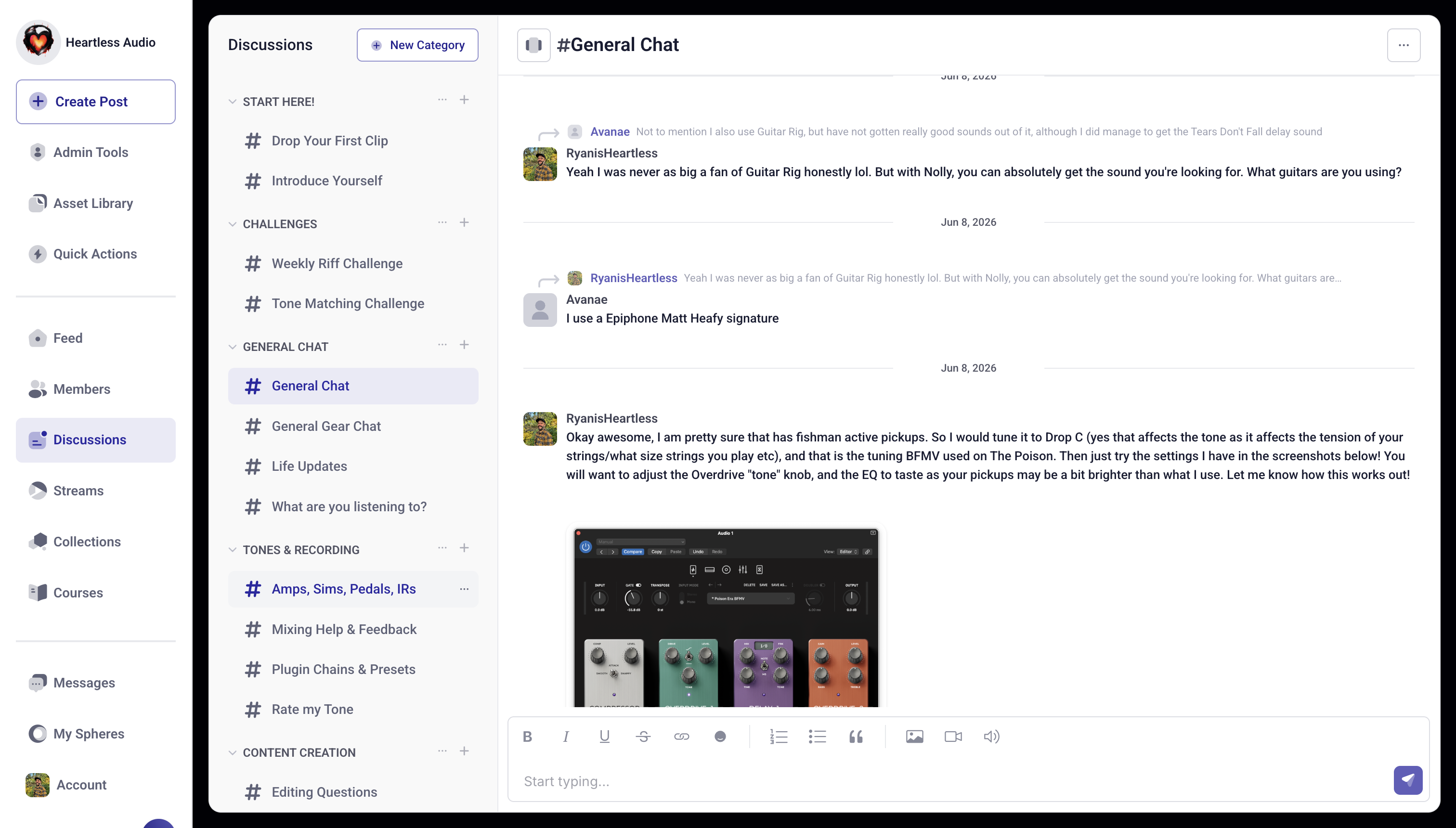
My Sphere gives me a dedicated space to share the content I actually enjoy making, talk to my members, answer questions about guitar and home recording, host discussions, and really build a deeper relationship with the people who already cared about what I do.
Sphere is great for more than just musicians, though.
Creators, influencers, coaches, educators, musicians, digital entrepreneurs… Anyone who wants to build a community they can actually own and monetize.
Sphere gives its creators a place to turn their audience into a real community, instead of relying on the social media algorithm overlords to show mercy on them.
Remember, social media can definitely help repeople find you, but a platform like Sphere can give your audience a place to land and build a real community with you.
Lets talk about that in a little more detail.
Online Communities vs. Social Media Audiences
This is going to be one of the most important distinctions for creators and brands to understand:
That an audience and a community are not the same thing.
You can have a huge audience without having a real community.
You can also have a relatively small community that is so much more valuable than a large, passive, doom-scrolling social following.
The difference will come down to the type of relationship you build.
Social Media is the Attention Game
Social media is built all around attention.
You post the content, but the algorithm decides who sees it, and then you have to hope enough people engage for the post to keep getting seen.
This can be incredibly powerful for discovery – there’s no denying that!
Platforms like YouTube, Instagram, TikTok, LinkedIn, and Facebook can help creators and brands reach people they would never have been able to reach otherwise.
But there’s also a huge downside: you will never fully control the relationship.
Your content can stop reaching people overnight. Algorithms change. Trends come and go. Accounts get flagged. Platforms shift priorities, making organic reach rise and fall uncontrollably.
If your entire business model depends on borrowed attention, it can become very stressful, very fast.
Online Communities Are the Ownership Game
On the other side of this creator economy, an online community gives its creators and brands a more direct relationship with their audiences.
Instead of relying only on an algorithm, you have a dedicated place where members intentionally show up.
This is the ownership game.
You aren’t just hoping someone stumbles across your post while scrolling.
You’re building a space people actually choose to join, and that changes the relationship dynamic entirely.
A follower might casually enjoy your content, if or when they see it.
But a community member has taken a far more intentional step. This could mean joining your free community, subscribing to your membership, taking your course, or participating in your discussions.
That kind of commitment level is entirely different.
Relationship Depth
Social media is usually built around increasingly shorter interactions.
A like. A comment. A view. A share.
Those things are useful, sure, but they don’t always create deep relationships, or relationships at all.
In a community, however, members can have realistically longer conversations. They can ask specific questions. They can share updates. They can get feedback and interact with each other.
That sort of depth is what makes communities so valuable to both the creator and the member alike.
People don’t just want access to more content in 2026. They want access to real connection, guidance, and real-life context.
Data and Audience Insights
Another major differentiator is the quality of insight you get from a community vs. a social media audience.
On social media, you might see views, likes, comments, watch time, and follower counts. These metrics do matter, but they only tell a small part of the story.
While inside an online community, you can quickly learn what your members actually want. What they need. What they desire.
You can see what questions they ask, what problems they all have, what resources and tools they use, what conversations they start, and what outcomes they want to achieve.
For creators, this can be especially useful information.
Your community can help you decide what content to create, what products to build, what courses to offer, and what problems your audience is actively trying to solve. All through their active, and thoughtful engagement.
Engagement Quality
Not all engagement is equal, however.
A viral post on Instagram can bring tons of attention, but that attention may not be very meaningful beyond a like or a share.
But a thoughtful discussion inside your community with 20 engaged members can be much more insightful than a post that gets thousands of passive views from people that will forget about you when they scroll to the next funny cat video.
This is exactly why creators should not just chase scale.
Scale is great when it is paired with depth.
But depth is what creates loyalty.
Long-Term Value
A social media audience can be powerful, but if it is 100% tied to the platform where it exists, what happens if or when that platform changes or ceases to exist?
A community has the advantage of becoming a long term asset.
It can support membership, courses, coaching, feedback, customer education, networking, and brand loyalty.
For creators specifically, this matters more because building a business is going to require more than just views.
Views are attention.
Community is a relationship.
Relationships are infinitely harder to replace.
How to Build an Online Community
Okay. We have talked a LOT about online communities in this guide!
So, how exactly you go about actually building one?
Building an online community doesn’t need to be overly complicated, especially in the beginning.
The goal shouldn’t be to create the perfect community on day one, either.
Instead, your goal is simply to create a focused space for the right people, and then improve it as you learn what your members really need (which you do by engaging with them and seeing what they say to each other).
I talked about how to grow a community over in another Sphere blog post, “How to Build an Online Community From Scratch” – but here are a few easy-to-follow steps:
Step 1: Define Your Audience
Start by figuring out who exactly your community is for.
Not vaguely… Specifically.
Instead of saying your community is for creators, ask yourself what kind of creators.
YouTubers? Musicians? Fitness creators? Coaches? People trying to leave their 9-5? Beginner creators with less than 1,000 followers?
The clearer your audience is, the easier it will be to create content, craft messaging, choose your platform, and ultimately attract the right members that will stick around.
Step 2: Define the Transformation
Once you know who your community is for, it’s time to define what they are trying to achieve.
What problem are they trying to solve?
What goal are they trying to reach?
What changes for them after joining your online community?
This does not always need to be a hard business result, either. The transformation could be learning a skill, feeling less alone, getting feedback, staying accountable, making friends, or becoming more confident in a specific area.
The important thing is that your community has a clear purpose beyond simply existing.
Step 3: Choose the Right Community Experience
Next, you need to think through what members will actually get once they join.
Will they get weekly posts? Live calls? Discussions? Courses? Events? Challenges? Direct access to you?
You really don’t need to offer everything.
In fact, you probably shouldn’t…
Just start with the few things that best support the reason people joined in the first place.
Step 4: Pick the Right Online Community Platform
Your perfect online community platform should make your community easier to run, not more complicated.
If you are building around paid memberships, you need monetization tools.
If you are building around education, you may need content and course features.
If you are building around discussion, you need a platform that makes member interaction easy.
This is where Sphere can be especially useful for creators, because it gives you a dedicated place to bring your content, members, discussions, and memberships together. Exactly why I chose Sphere for my own community for Heartless Audio.
Step 5: Launch, Listen, and Improve
Your first version of your online community isn’t supposed to be perfect.
But you should launch with a clear target audience, a clear purpose, and a simple experience for your members.
Then… Pay attention!
What do members respond to?
What questions keep coming up?
What content actually helps?
What feels unnecessary?
The best communities improve over time because they are built with members, not just for them!
Ready to Build Your Online Community?
So, are you ready?
Seriously… Are you ready?
Because an online community is more than a group chat, more than a social media page, and more than just another collection of followers.
At its best, an online community is a digital space where people come together around a shared purpose, build relationships, learn from each other, and feel like they are part of something greater than just themselves.
For members, that can mean support, growth, accountability, connection, and most importantly: belonging.
For creators, brands, and businesses, it can mean stronger relationships, more loyalty, better feedback, increased engagement, and a more sustainable way to create long term value.
That’s why online communities have become such a big part of the creator economy in 2026.
Remember: social media can help you attract attention.
But an online community helps you build relationships.
And in the long run, relationships are what create lasting value and a sustainable creator business.
If you’re a creator who wants to turn your audience into something deeper, Sphere gives you a place to bring your content, members, and community together.
I have built my own community on Sphere with Heartless Audio, and it has given me a much more direct way to connect with the people who already care about what I do.
If you are ready to build your own online community, sign up for a free Sphere and start your community today.
Best of luck, and see you inside Sphere!
Frequently Asked Questions
What is an online community?
An online community is a digital gathering place where people who care about the same topic, hobby, goal, or purpose regularly interact, build relationships, and learn from each other. Unlike a traditional audience, community members actively participate instead of simply consuming content.
What are some examples of online communities?
Online communities come in many forms, including creator communities, brand communities, customer communities, professional communities, interest based communities, and learning communities. Popular examples include Reddit, Discord, Facebook Groups, and creator communities built on platforms like Sphere.
What is the difference between an audience and an online community?
An audience is mostly one-way communication between a creator and their followers. An online community encourages interaction in every direction: creator ↔ members ↔ members. That member-to-member interaction is what creates a stronger sense of belonging and long-term engagement.
How do online communities make money?
Online communities can make revenue through paid memberships, coaching, courses, exclusive content, community events, and other premium experiences. For creators, communities provide a more stable source of recurring income than relying solely on social media platforms and algorithms.
Why are online communities important for creators?
Online communities help creators build deeper relationships with the people who care most about their work. While social media is great for discovery, communities create meaningful interaction, immediate and invaluable feedback, stronger member relationships, and a more sustainable business built around connection instead of algorithms.