


Most established creators and online businesses don’t have an audience problem – they have an ownership problem!
You can build a massive following on social platforms like Instagram, YouTube, TikTok, X, and LinkedIn… and still have no reliable way to reach your followers, no direct relationship with your audience, and no real business asset to show for your work.
That’s the difference between a rented social audience and an owned online community in the new creator economy.
So in this guide, I’ll show you how to build an online community from scratch in 2026.
You’ll discover how to define your niche, choose the right community management platform, attract your first members, and turn your community into something valuable for both your members and your business.
Let’s start with what an online community actually is – and why it matters more than ever.
What is an Online Community?
An online community is a dedicated space where a specific group of people come together around a shared interest, goal, or identity – not just to consume content, but to interact, contribute, and belong.
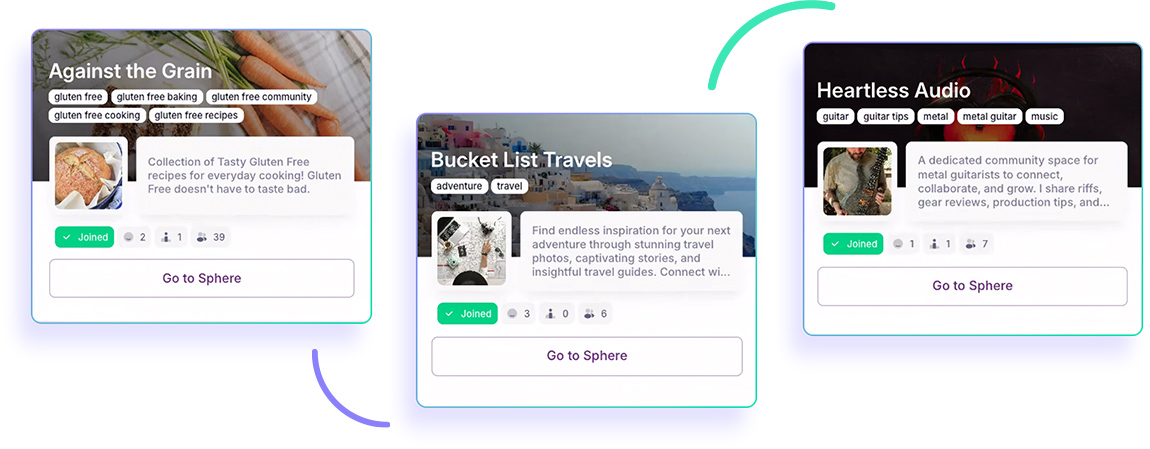
In most cases, an individual creator or brand sits at the center of that community, providing structure, guidance, and valuable content.
But a community differs from typical social media sites based on what happens among its members.
With social media, your total organic reach is controlled by algorithms, while an online community gives you a direct line to your audience in a space you control.
The online community is also much more than a traditional online forum, because it’s built around a central figure and has a much richer and more diverse set of formats to engage with, from discussions and online courses to live streams and DMs.
In a well-run community, members don’t show up just to passively consume content. They show up for:
- Discussions
- Feedback
- Relationships
- A sense of belonging
For creators and businesses, this is where the value starts to compound – both the intangibles of a stronger, tight-knit brand and the hard numbers of customer lifetime value (LTV).
Instead of broadcasting to the wider world, you’re cultivating a space where your true fans are gathering, engaging, and becoming more invested over time.
When done right, an online community isn’t just another platform to manage. It’s actually one of the most valuable assets in your business, contributing to important business goals like acquisition, activation, and retention.
Why Should You Build an Online Community in 2026?
You should build an online community because it’s your way out of what I call the Attention Game.
You post content, hope the almighty algorithm picks it up, and cross your fingers that a fraction of your followers actually sees it.
Social platforms have become increasingly “pay to play,” so even a massive following doesn’t guarantee meaningful organic reach.
That’s why the most successful creators and brands are shifting from renting their audience to owning a real business asset: an online community.
Here are three reasons why this shift is critical:
1) Direct Distribution
On social media, a third-party algorithm stands between you and your hard-won audience. If that algorithm changes – or your reach is throttled for any reason – then your connection to your followers vanishes overnight.
An online community gives you direct distribution. Whether you’re launching a new digital product, sharing a newsletter, or hosting a live stream, you have a direct line to your members in a space you control.
You no longer have to pay for ads or "play nice" just to talk to the people who already chose to follow you!
2) Converting “Views to Value”
Social media is perfect for discovery and awareness – a top of funnel stage of inteeracting with your audience.
But when does a social media user who’s scrolling actually stop, get to know you and your brand, tap over to your bio, click the link, and go buy something?
It’s not never, but it’s also not common!
The truth is, you have to stop squeezing the entire customer journey into a single social media platform. A private community is the best place for actual business to happen (the “value” piece of views to value).
Think about it: you’re moving your most engaged followers and true fans into a place where you can actually reach them and deliver deeper value than you ever could on social media.
3) A Self-Perpetuating Content Engine
In the Attention Game, you’re stuck on a content hamster wheel. If you stop posting, your momentum slows down and eventually stops.

But in a thriving online community, your members will start creating value for each other.
Community members will:
- Answer questions
- Share insights
- Start discussions
- And contribute their own experiences
There’s true business value to this “user-generated” content. It keeps your community active, even when you’re not posting constantly.
And just as importantly, you get real-time insight into what your audience actually cares about, which makes everything in your business – from content creation to product development – easier and more effective!
This is the shift from the Attention Game to the Ownership Game in action!
Building an Online Community in 7 Steps
With the goal of the Ownership Game in mind, let’s talk about how you build your own online community from scratch and lean into community-led growth for business success!
The good news is, even if you are brand-new to digital community creation, you can start attracting members into your community starting on day one.
- Define the Purpose of Your Community
- Identify Your Niche and Ideal Members
- Choose an Online Community Management Platform
- Design the Member Journey Before Launch
- Invite Your Founding Members
- Engage with the Wider Community
- Monetize Your Community
Step 1: Define the Purpose of Your Community
Every successful online community starts with a clear “why.”
If your community doesn’t have a specific purpose, it’ll quickly become a ghost town. You need to define what your members will actually do – and if you’re in a problem-solving niche, what kind of transformation is expected for the members of your community?
Why does your group exist, and more importantly, why will people want to join?
Your "why" gives the online community its purpose and helps structure everything else around it.
I recommend defining your purpose in two ways:
- Internal Why: How does this community serve your business? (For example, “to increase customer retention for my fitness app” or “to build a pipeline of warm leads for my coaching services.”)
- External Why: What do your members get out of it? (For example, “to lose 10 pounds in 30 days with peer support” or “to master jazz piano through weekly feedback.”)
Quick Tip: Don’t build a community just to “have a community.” Build it to solve a specific problem.
Whether you’re a musician sharing music theory knowledge or a corporate consultant teaching leadership, your community should be the shortcut to results for your members.
(Don’t worry, I’ll talk more about what that looks like in later steps.)
Now, with a clear purpose for you and your audience, it’s time to narrow in on the exact niche and initial members you’ll find for your community.
Step 2: Identify Your Niche and Ideal Members
One of the biggest online community mistakes I see creators make is trying to build a community for "everyone."
When you target everyone, you resonate with no one. To build a thriving online space, you need to be laser-focused on choosing your online community topic.
Your ideal members are the people who are most likely to move through your Views to Value pipeline. They aren't just casual viewers – they are "problem-solvers" looking for a specific outcome.
Here is how this looks across different creator niches:
- The Health & Wellness Creator: Instead of a "Fitness Fans" focus, your niche might be "Busy Moms looking for 20-minute HIIT workouts they can do at home."
- The Corporate Educator: Instead of "Business Professionals," your niche might be "First-time managers in tech struggling with remote team communication."
- The Photographer: Instead of "Camera Lovers," your niche might be "Aspiring wedding photographers looking to book their first $5k client."
- The Musician: Instead of "Music Fans," your niche might be "Intermediate guitarists who want to learn how to write and record their own metal tracks." (A personal favorite of mine!)
Now, how do you find your niche?
If you’re already an active content creator, look at your most popular content and your most frequent comments.
What is the #1 question people ask you? What is the specific pain point they keep mentioning?
That is the "seed" of your community niche!
Step 3: Choose an Online Community Management Platform
Every online community needs a digital home base.
What sets an online community apart from a social media following is that it’s on a platform you control where you can host content, discussions, and events – and where your members will gather to engage with you and each other regularly.
To make your vision a reality, you need to choose a platform that can host your community.
Hosted Platforms
Some platforms are publicly hosted, such as a Facebook group or a Discord server.
These may be acceptable if you are just starting to build your community, but they still have the downside of being "rented land" for your gathering place and have a limited scope for sharing content or courses.
These platforms are not entirely yours and don't have the features you might need to truly lead your group, such as crafting a customized, branded experience or smoothly monetizing your content and online experiences.
Private Platforms
In contrast, there are also several platforms designed to help you build a private group space that is entirely yours.
When you're ready for a lot more control over your network, you'll want to look into a dedicated online community management platform.
Popular ones you may have heard of include LearnWorlds, Mighty Networks, or, lately, Skool.
But I also want to make sure you know about a new creator community platform called Sphere!
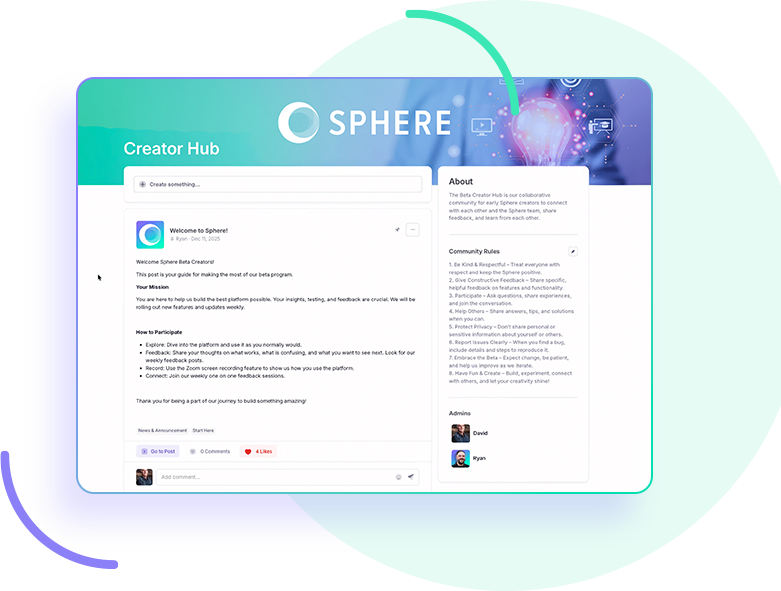
Sphere is an all-in-one platform that lets you launch and grow a community with no upfront cost. And Sphere ensures that there is no need to rely on third-party payment processors to get paid. Because Sphere IS the payment processor.
If you’re ready to start a community, sign up for Sphere!
Step 4: Design the Member Journey Before Launch
Before you can invite members to your online community, you need to craft your member experience.
What will new members see when they arrive? How can they engage with your platform immediately after making their account, and what will convince them to come back tomorrow?
It’s important to carefully design the experience for members. Think about why they're joining and have a curated journey for them that will leave a positive impression, from your branding to a welcome video and discussion ideas.
Have the full journey ready to welcome new members before you open your virtual doors to everyone. The first impression is crucial – a strong one encourages new members to return and become a regular part of your community.
Step 5: Invite Your Founding Members
One of the biggest challenges of managing a community is getting past the initial hurdle of no members or engagement. When you invite members into an inactive space, they don’t see anything worth sticking around for.
That’s why it’s important to get your most engaged followers as initial members.
Start with a few handpicked people from your audience, email list, and DM connections. Frame your outreach as an invitation to an exclusive space focused on shared interests, not a promotion.
Say something like "I’m building a space for ____ and I would love your input before I open it."
This approach will make your potential power users and top audience members feel like VIPs and consulted experts.
The members will give helpful early feedback to improve the experience before you open it up to everyone. Inviting your founding members exclusively also creates some initial social proof and buzz.
Quick Tip: If you’re serious about your community, it may even be worth incentivizing a few people to be active founding members so there’s always discussions and engagement going on. That could mean payment, but it could also include other perks or arrangements. Get creative!
Step 6: Engage with the Wider Community
Once you have gathered your initial founding members, it's time to open up recruitment to the greater online population of people who share your interests. If you’re a content creator, that means linking out to your community from your video descriptions, blog articles, social media bios, and emails.
Now is also the time for direct personal engagement with your growing network of members. Once a community is open and on the rise, the owner or manager should be extremely engaged and active for at least the first 30 days.
This process isn’t necessarily scalable, but it’s still a critical stage for directed growth. Think live calls, weekly themes, or prompted discussions where you're an active participant.
The idea is to add unreasonable value early so that joining and engaging is a no-brainer for your audience at this critical stage.
Ideally, your first members will feel overwhelmed by the value they're getting, and that can keep the momentum going.
If you do that, you may even get members to bring in new members in a virtuous cycle!
Step 7: Monetize Your Community
The final step is to monetize your platform. You want all of that growing engagement to become a pillar of your business or creator income.
Now, it’s always a good idea to define how to monetize a community before you start one – and platforms like Sphere make it possible to make money with paid online courses, paid membership plans, and more.
The good thing about charging money is it weeds out the less-interested members of your audience and helps you gather together the people who really want to support you.
The bad thing about charging money is it limits your growth, especially in those early days, and could make it hard to achieve critical mass in your community with enough members to keep engagement high.
There are several potential methods for monetizing through your online community that your audience can enjoy engaging with:
- Paid membership tiers
- Online courses
- Digital product sales
- Coaching and consulting
- Affiliate marketing and brand sponsorships
You can incorporate just a few of these monetization pillars into your community, or plan to make money with all of them.
But I recommend starting from a place of offering genuine value to your community first, and then building out a structure to charge for that value.
The creator community platform you choose and the "why" of your community will both shape the way you monetize it.
Use your insights into the priorities, motivation, and budget of your community to determine the perfect balance of value offering, availability, and pricing.
Putting it all Together
What comes next after these 7 steps to build an online community from the ground up?
It's important to keep the momentum going. Stay engaged and responsive with your group, release new exclusive content and host events on an established schedule that they can count on, and cultivate constant engagement.
The keyword here is “exclusive.” Put out content that your audience won’t find anywhere else, and give them direct access to you through your community – whether you’re an entertainer, a problem solver, or a little bit of both.
Remember that communities are like a living organism that can grow and evolve.
Ideally, they’ll reach a point where the members are the glue that holds it together and adds value – maybe even more than you do!
Ready to Start Your Community?
With all that said, what is Sphere?
Sphere a private community platform by creators, for creators, and it’s the perfect place to launch your own online community – whether you already have an existing social media following or you’re starting from scratch.
An online community is an invaluable asset where all your true fans gather to connect, learn, and engage. You can count on your Sphere community to reach your audience directly, add value, and make money.
If you’re ready to start your Sphere community, sign up for Sphere and we’ll see you inside!