


Choosing the best online community platform in 2026 really isn’t as simple as just picking the one with the longest list of features.
Because here’s the thing…
Most communities don’t fail because the creator runs out of content ideas.
The reason communities fail is that they were built in the wrong place from the get-go.
A Discord server might be the perfect space for a gaming community, but it could be completely overwhelming for a professional coaching group. A Facebook Group is easy for members to join, but you’re still stuck building on someone else’s platform.
And a full business platform like Mighty might be great for courses and funnels, but entirely too much if all you really need is a focused place for your members to connect.
So, the “best” online community platform actually depends on what kind of community you are trying to build.
Are you a creator ready to turn your audience into paying members?
Are you a coach building your next cohort or mastermind?
Are you a brand looking to support customers and build brand loyalty?
Or are you really just trying to create a calmer and more intentional space where your people can actually talk to each other without getting buried under algorithms and ads?
That is what we’re going to break down today.
Instead of just giving you a generic list of all the community platforms out there, let’s take a look at the best online community platforms by use case, so that you can choose the one that actually fits you and your community's needs!
Best Online Community Platforms by Use Case
Before we jump into the full breakdown here, I think it’s important for me to say this upfront:
There is no such thing as a perfect online community platform for everyone… No “one size fits all.”
Super annoying answer, right?
Let me explain…
The best platform for a YouTuber selling a paid membership might not be the best platform for a software company trying to reduce its inbound support tickets. Just as the best platform for a Course Creator might not be the best platform for a gaming community. And the best platform for a small, private coaching group might be entirely different from the best platform for a huge, free “fan community.”
So instead of pretending every platform does the same thing (they don’t), let’s break them down by what they’re actually best for.
Online Community Comparison
| Platform | Best For | Free Plan | Paid Memberships | Courses | Live Chats | Cost |
|---|---|---|---|---|---|---|
| Sphere | Creators building owned communities | ✅ | ✅ | ✅ | Limited | Free (up to 100 members), then $149/mo for Pro |
| Circle | Community businesses | ❌ | ✅ | ✅ | Limited | Starting at $89/mo (Professional) |
| Mighty | Courses + community | ❌ | ✅ | ✅ | Limited | Starts at $79/mo (Launch) |
| Patreon | Fan memberships | ✅ | ✅ | Limited | Limited | Free to start (Patreon takes a percentage of creator earnings) |
| Discord | Gaming & Real-time chat | ✅ | Limited | ❌ | ✅ | Free (Nitro optional for users; Server Subscriptions available for monetization) |
| Groups | Free audience communities | ✅ | ❌ | ❌ | ✅ | |
| Skool | Coaching communities | ❌ | ✅ | ✅ | ❌ | $9/mo (hobby), $99/mo (single plan) |
| Kajabi | Course businesses | ❌ | ✅ | ✅ | ❌ | Starts at $143/mo (Basic plan) |
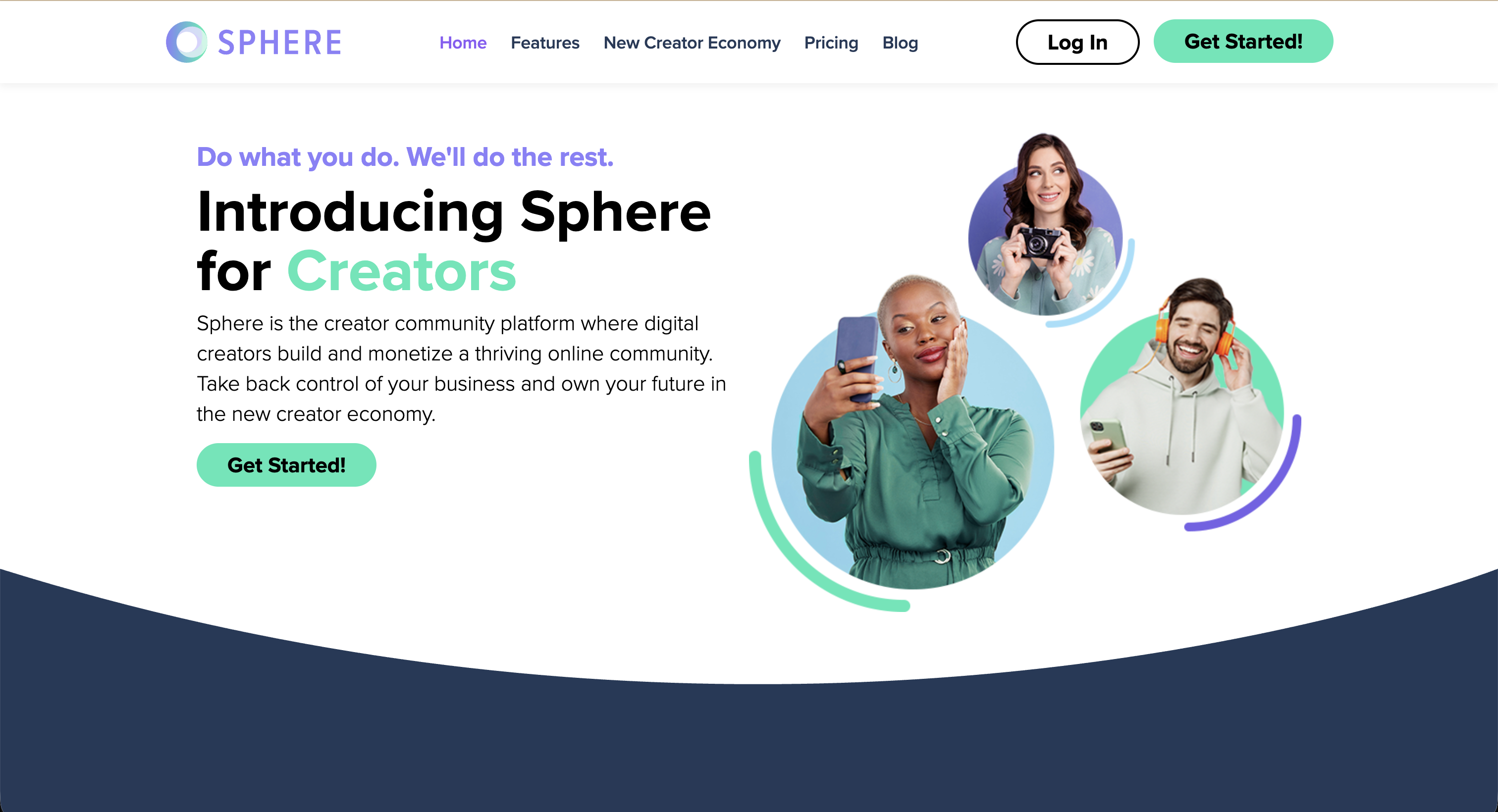
1) Sphere: For Creators who want an owned community, content, and membership platform
Who is Sphere for?
Creators, coaches, educators, musicians, and digital entrepreneurs who want to build a community they own, with content, courses, memberships, and direct member relationships.
Sphere is built for creators who want more than just a comment section or a group chat, and much more than just another social media profile controlled by the algorithm deities.
And I think this distinction matters a ton…
Because if you’ve been a creator for any length of time, you likely already know what it feels like to spend years building your audience on Instagram, YouTube, TikTok, or Facebook, just to have an algorithm decide whether or not your audience even sees your content.
Fun stuff, right?
Thankfully, Sphere gives creators a dedicated space to bring their audience, content, and community all together in one place that can be monetized (if they want). You can create free or paid membership tiers, share your content, build out courses, host discussion forums, and create a much more intentional experience for the people who really care about what you do.
This is why I personally chose Sphere to build out my own community at Heartless Audio: I didn’t want just another noisy group chat.
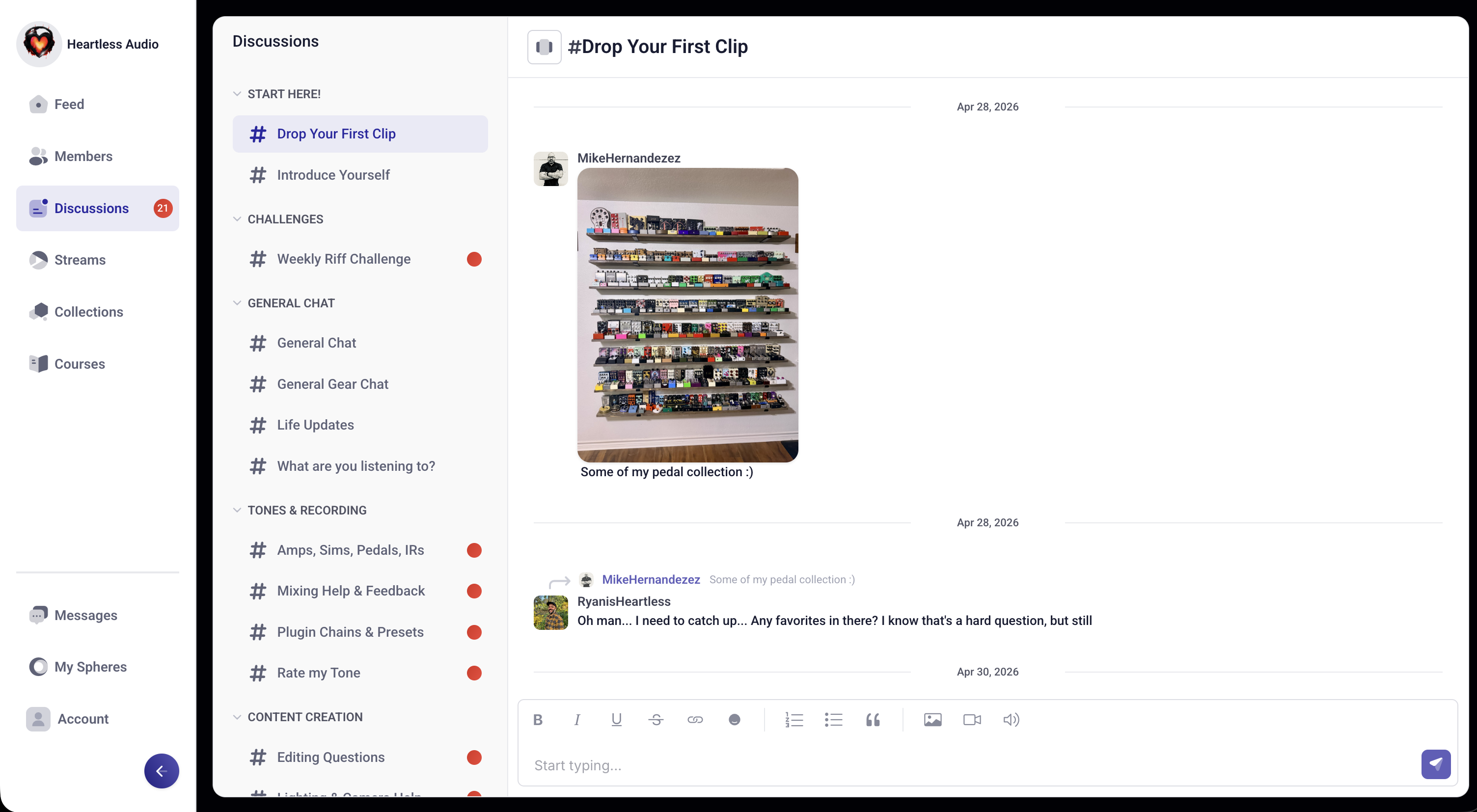
I wanted a place where I could share the content I actually like making, talk to people like myself, and build something that felt more connected and real than a chaotic social media feed.
Sphere Pros
Sphere gives creators a dedicated space to build a real community and not have to rely solely on social media platforms.
It supports free and paid memberships, which makes it super useful whether you’re just starting to build a community or already have an audience.
It also brings together community, content, courses, and monetization tools, which helps creators avoid having to stitch together 10 different tools.
The biggest win, though?
Ownership.
You’re not just hoping the algorithm shows your next post to the right people. You are giving your audience a place to show up with purpose, to interact with you and each other.
Sphere Cons
Sphere may not be the best fit if you’re trying to build a massive, free chat community where thousands of people are posting constantly throughout the day.
If your community needs the real-time chaos and energy of something like Discord, Sphere may feel a bit too structured to you.
And if you’re looking for a huge enterprise-level platform with endless customization, complex sales and click funnels, and every possible business tool under the sun, you may want something more heavy-duty than Sphere.
But for a lot of creators, those “cons” are kind of the point…
Not every community needs to be unnecessarily complex. Sometimes, they just need more focus.
Best Use Cases for Sphere
- Paid creator communities
- Coaching communities
- Course-based communities
- Music, fitness, education, and creator/influencer communities
- Niche communities built around a specific transformation
- Communities where depth matters and noise is unwanted
When to Choose Sphere
You should choose Sphere if you’re a creator who wants to turn your audience into a real online community.
Not just followers or subscribers.
Not just people who occasionally comment the fire emoji under your post and then are never seen again.
A real community.
Sphere can be an especially strong choice if you want to build a paid membership to share content or courses, and create a deeper relationship with your audience.
So if your goal is to build a sustainable creator business around real human connection instead of algorithms and chaos, Sphere may be one of the strongest choices on this list.
Sphere’s pricing is straightforward: Start for Free (capped at 100 members and a flat 15% transaction fee), or upgrade to Pro for $149/month.
Want more details? Click the link for our in-depth "What is Sphere?" guide.
2) Circle: For Established Creators and Brands Who Want Flexibility
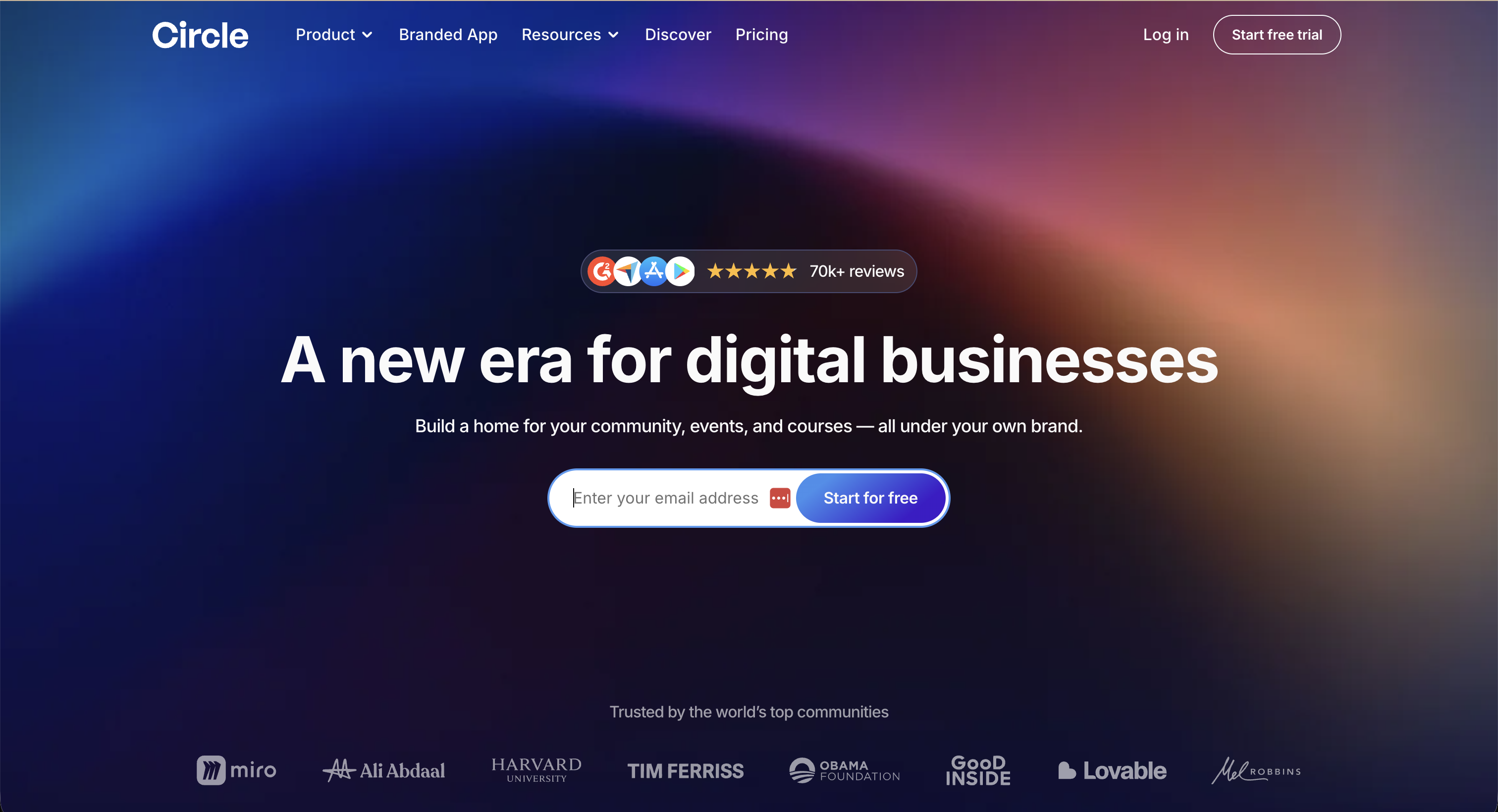
Circle is best for: Established creators, course sellers, educators, and brands who need a flexible community platform with many tools and high levels of customization.
Circle is one of the bigger names out there in the online community platform space, and with good reason.
It is built to bring together community, courses, events, live streams and email under one platform.
So if you’re looking for a platform that can handle many different community and content type needs, Circle could very well be a strong option for you.
It can definitely work well for creators, but also for coaches, educators, and companies that want more control over their customer/community experience.
Circle Pros
Simply put, Circle is very flexible.
You can build community spaces, host courses, run events, and create a more “branded” experience than you would get from something like a Facebook Group or Discord Server.
It’s also a great option if you already have a more developed business, and need a platform that can support the various parts of that business.
So if you’re running courses, memberships, events, and community all in one, Circle gives you plenty to work with.
Circle Cons
All of that flexibility can certainly come with a downside.
Circle can be more than most beginners need, especially if you’re just trying to launch a simple paid community and test out your idea.
More features can be great, but only if you actually need them.
If not, you may end up spending way too much time building the perfect community setup instead of actually getting members in the door and interacting with them.
Decision paralysis, anyone?
And let’s be honest…
Creators, myself included, love overbuilding and overthinking.
Best Use Cases for Circle
- Course communities
- Paid memberships
- Creator businesses with many offers
- Brands that need a more polished community experience
- Communities that need a ton of customization
When to Choose Circle
You’ll likely want to choose Circle if you’re in need of a flexible, polished, and more customizable online community platform.
It is especially useful if you already know your community is going to need courses, events, email, and many different content areas from the start.
If Sphere feels more focused and “creator-first”, then Circle feels more like a Community Operating System.
This can be great, as long as you actually need all of those extra moving parts.
3) Mighty Networks: For Larger Courses, Memberships, and Community Businesses
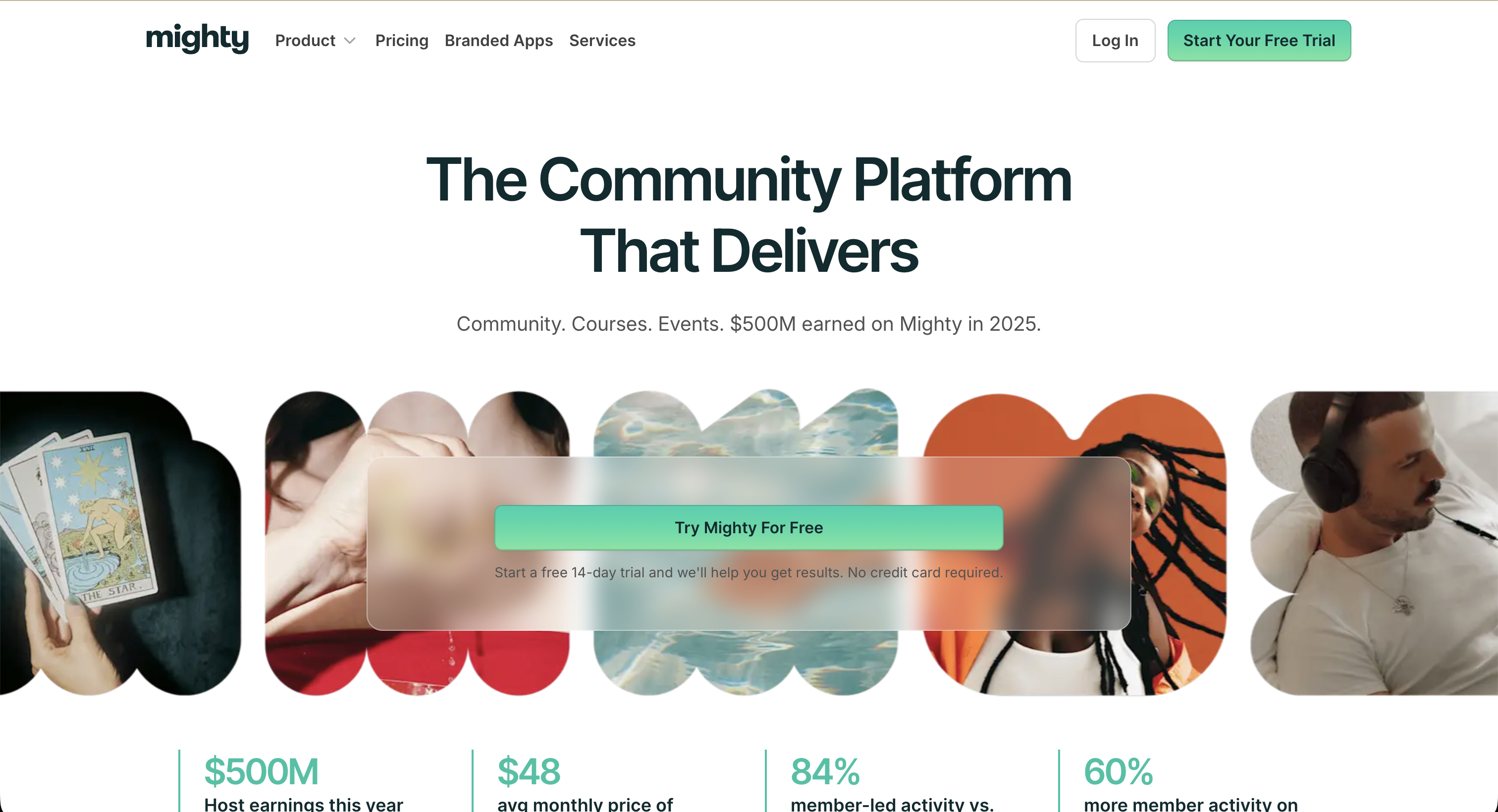
What is Mighty Networks best at?
Mighty can be the best option for course creators, coaches, entrepreneurs, and brands who need a more complex platform for community, courses, memberships, live events, and branded experiences.
Mighty Networks is another well-known platform in this space, especially for larger or even enterprise-level creators and businesses that want to combine memberships, courses, events, and community into one place.
This is a truly powerful option, especially if you’re building a bigger overall community business and need a platform that can grow with you.
Mighty can be a great fit for those larger creators who aren’t just building a small community, but rather a larger ecosystem – one built specifically around their content and offerings.
Mighty Pros
Mighty has a LOT of functionality to support its users!
You can build a community, create courses, sell memberships, host events, and organize your offerings in many different ways.
This platform also designed to support more developed community businesses, which can make it especially attractive if you already know what you want and need to build something bigger than a simple membership space.
So if your vision is a full community-based business, Mighty could give you a lot of room to build.
Mighty Cons
The biggest downside I have seen is that Mighty can feel very overwhelming if you’re just getting started.
Platforms can be super powerful and still be more than you need.
If you’re a solo creator trying to launch your first paid community, too many features and a steep learning curve can become a distraction and a barrier.
You might find yourself building funnels, spaces, courses, and an overly complicated structure before you even know what your members might actually want.
Not the best use of your time, if you ask me.
Best Use Cases for Mighty
- Larger membership communities
- Course-based businesses
- Coaching programs
- Professional networks
- Brand communities
When to Choose Mighty Networks
You’d want to choose Mighty if you’re building a larger community business and want a platform that can support your courses, memberships, live events, and a more complete branded experience.
It can be a great fit for your business if you already have an audience, a clear, tested offer, and a plan to grow and scale your community.
But if you’re still researching and testing your community idea, Mighty might be way more platform than you need on day one.
4) Discord: For Real-Time Chat and Communities
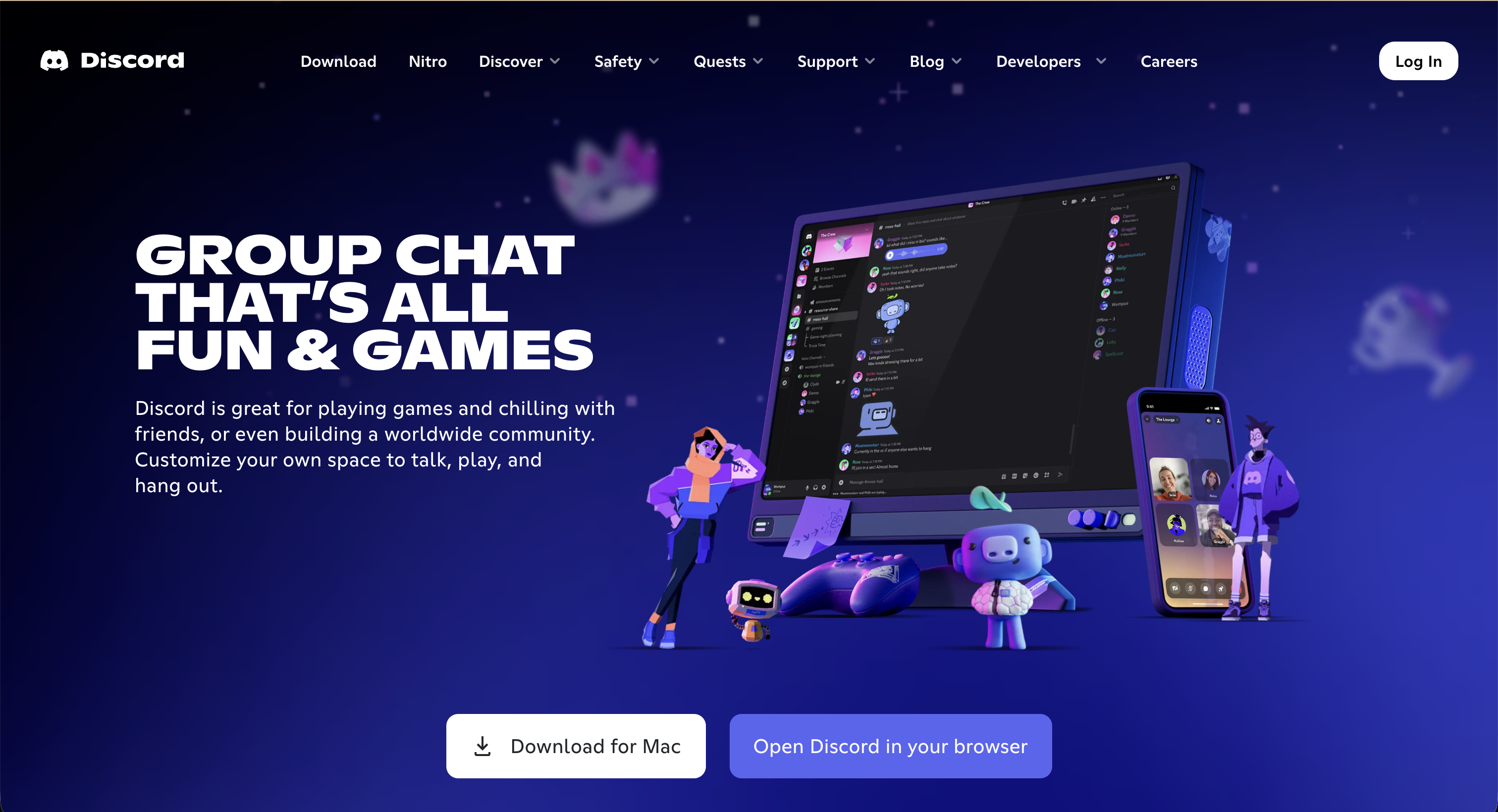
What is Discord best for?
Gaming communities, fan communities, hobby groups, crypto communities, music/band communities, and any group that thrives on or needs fast paced conversational capabilities.
Discord is one of the most popular and recognizable community platforms out there, especially for gaming and fandoms.
And to be clear, Discord can be an extremely strong choice from this list.
If your community needs constant conversation, live voice channels, fast responses, and a casual hangout vibe, Discord is very hard to beat.
It also helps that it’s familiar to a lot of people, easy to get started, and free to use in a lot of cases.
But it’s also definitely not the right fit for every community.
Discord Pros
Discord is Excellent for real-time conversations and interaction.
Members can chat, jump into voice channels, share many types of media, create discussion threads, and hang out in a virtual way that feels immediate.
This makes it a great fit for communities where the main goal is conversation itself.
That means gaming communities, fan groups, and music communities can all thrive on Discord.
Discord Cons
Discord can get overwhelming… fast.
If you have ever opened a Discord server to find 47 unread channels, 877 unread messages, and 15 different inside jokes you don’t understand… You’ll know what I mean here.
For paid coaching groups, structured educational communities, or professional communities, all of that noise can be a huge problem.
Important conversations get buried. New members can feel lost and overwhelmed.
And if the community grows? Moderation can become a serious (nearly full-time) job.
Discord is great when energy is what matters most, but it is not so great when focus is what matters most.
Best Use Cases for Discord
- Gaming communities
- Fan communities/fandoms
- Creator hangouts
- Music/artist communities
- Crypto/tech communities
- Free communities
When to Choose Discord
I would choose Discord if my community depended on fast, casual, real-time chat and interaction.
If your members want to hang out (virtually), chat, share memes, jump into voice channels, and talk throughout the day, Discord can be a great choice.
But if you’re building a paid coaching community, course community, or professional group, you may want and need something with more structure and features.
5) Facebook Groups: For Simple, Familiar, Free Communities
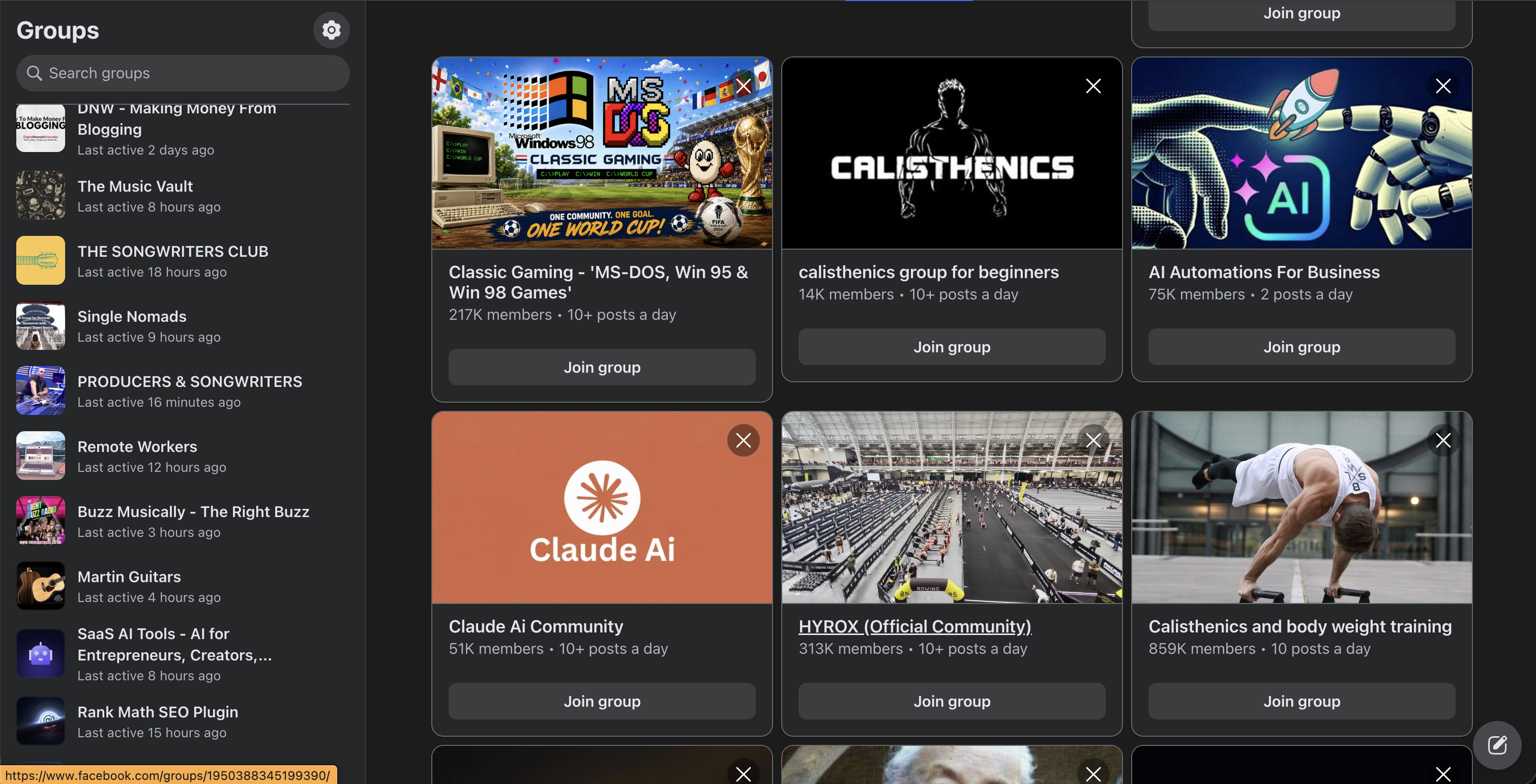
Facebook Groups tend to be best for local groups, hobby groups, free audiences, and creators who want the lowest possible barrier to entry… these being free and all.
Facebook Groups is likely one of the most familiar online community platforms out there, even though many wouldn’t consider it an online community.
Because so many people already have Facebook accounts, using Facebook Groups is very accessible for members. They don’t need to download a new app or learn an entirely new platform.
This makes Facebook Groups useful if you want to start a free community quickly and keep things simple.
Facebook Groups Pros
Facebook Groups are easy to join, easy to use, and familiar to potentially billions of people around the world.
They can work really well for local communities, parenting groups, and broad-interest groups (I am a member of at least 4 different guitarist groups on Facebook).
Because so many people are already on Facebook, there’s definitely a lower barrier-to-entry for people to join your community. That’s the main benefit of Facebook Groups.
Facebook Groups Cons
The biggest downside, and you’ll start to notice a pattern here, is ownership.
You’re still building your community on Facebook – and if your goal is to build a community that you have control over, that’s a problem.
Being on Facebook means your reach, rules, moderation tools, notifications, and member experience are all tied to Meta’s platform, and you have little control over any of it.
You also have to deal with all the normal distractions of Facebook itself too.
For example, your members might be coming for your community, and then leave 20 minutes later after arguing with their uncle and grandpa about politics.
Monetization can be difficult or impossible without using other third-party platforms in addition to Facebook Groups.
Not ideal…
Best Use Cases for Facebook Groups
- Free communities
- Local/neighborhood groups
- Parenting groups
- Hobby groups
When to Choose Facebook Groups
Facebook Groups would be your best bet if you need a simple, free, and familiar space to bring people together.
But if you’re trying to build a paid membership (monetization), own the member relationship, or create a more intentional creator business, you’ll likely outgrow a Facebook Group sooner rather than later.
6) Patreon: For Fan Memberships and Supporting Creators
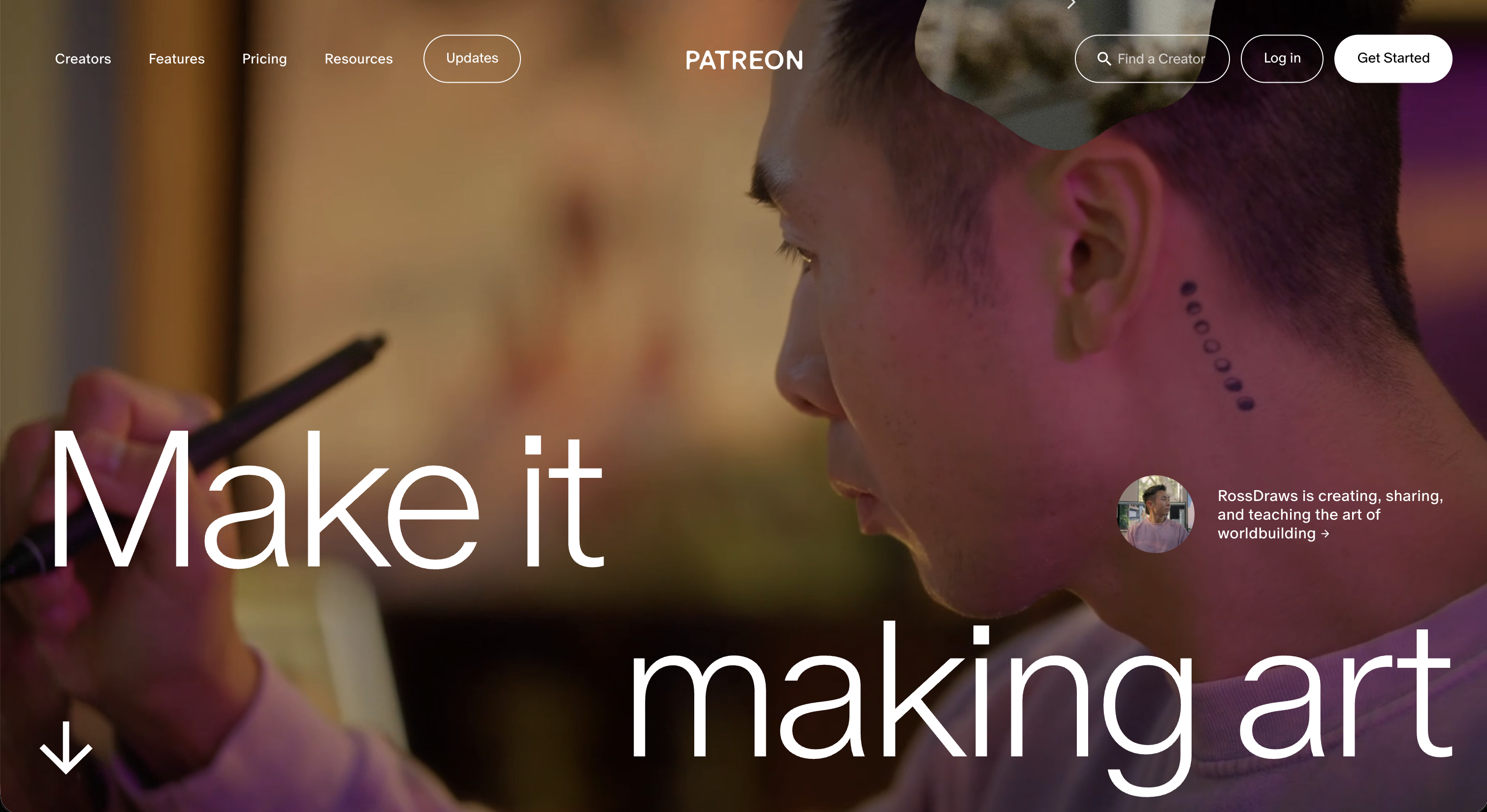
Patreon, another one of the most well-known online communities, can be best for artists, podcasters, YouTubers, writers, musicians, and creators who want to monetize fan support with memberships in exchange for exclusive content and assets.
Being one of the most recognizable creator membership platforms makes Patreon especially popular with creators who want to offer paid tiers, exclusive posts, bonus content, behind the scenes updates, and garner direct support from their fans.
At its core, Patreon is still more of a fan-membership platform than a true community-first platform, at least in my opinion.
Patreon Pros
Patreon is familiar to many creators and their fans.
The site is relatively easy to understand: fans support the creator, and the creator gives them perks, content, or access.
All of this makes it very useful for creators with a larger personal brand and/or fan base.
Patreon Cons
For fans, Patreon can feel very transactional.
If your main goal is member-to-member or member-to-creator interaction, Patreon may not always be the best fit.
Don’t get me wrong, it can and absolutely does work for fan memberships. But if you want deeper discussions, courses, events, and a more owned community environment, you’ll likely feel limited on Patreon.
In other words, Patreon is great when the main relationship is: Fan → Creator.
But if you want a more Creator ↔ Member ↔ Member arrangement, you’ll benefit from a more community-focused platform from this list.
Best Use Cases for Patreon
- Fan memberships
- Podcasts
- YouTube memberships
- Behind-the-scenes content
- Bonus content
- Supporting creators
When to Choose Patreon
I would choose Patreon if you know your audience already wants to support your creative work, and you want a simple way to offer paid tiers and exclusive content.
This can be especially useful for artists, podcasters, writers, and musicians with extra content to offer.
But if you’re trying to build a more personal and interactive online community, Patreon may not be the best option by itself. This is why many Patreon creators end up having to also set up platforms like Discord to use simultaneously for the community piece, which can further fragment their fans.
Patreon is well-known and certainly a good starting point for making some money from your fans, but I’d argue that anyone aiming for a mature business can find more favorable payment terms on other platforms.
7) Kajabi: For Course Creators and Digital Product Businesses
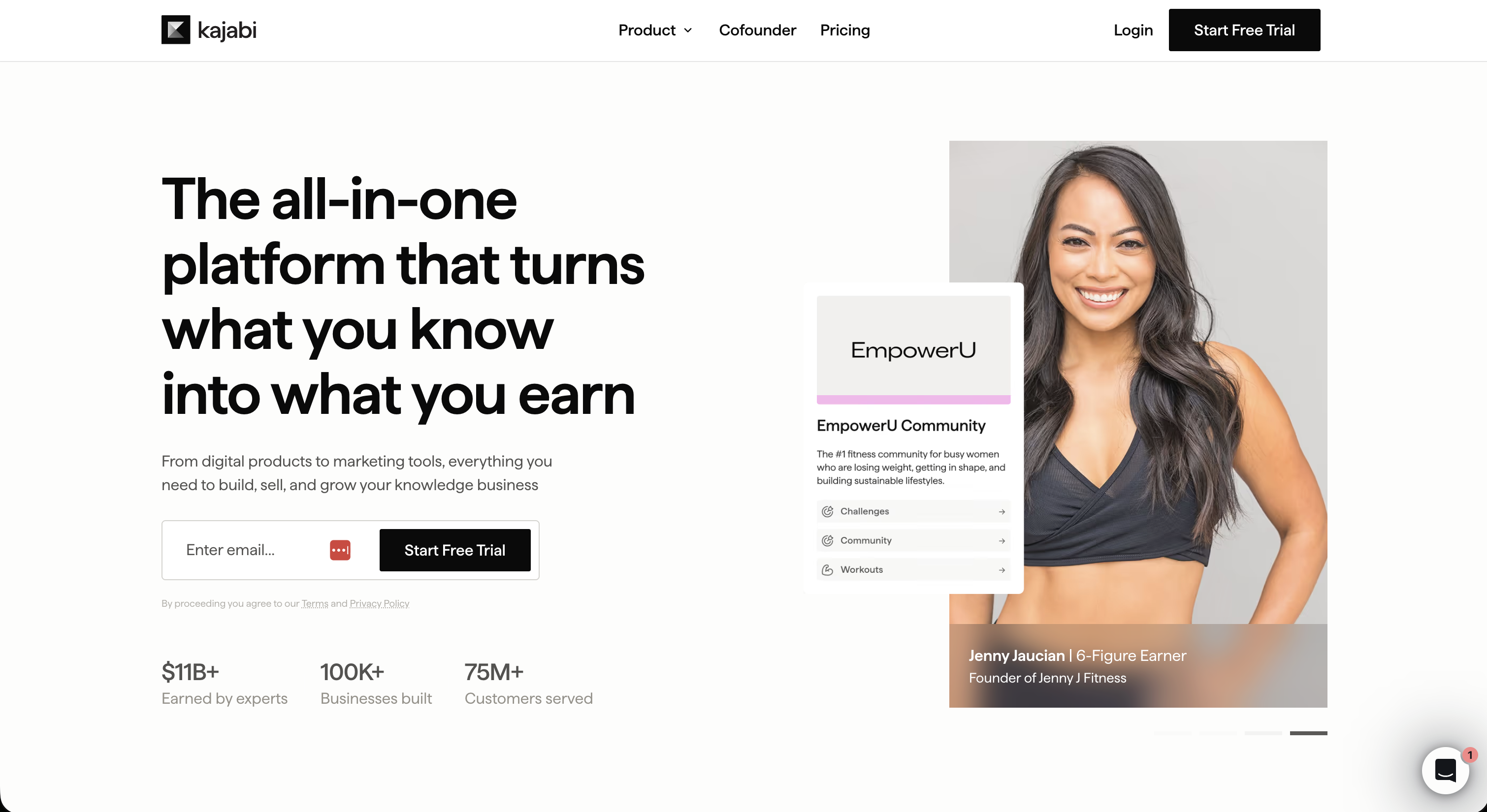
Kajabi may not be a name you’ve heard, but it’s very popular in the online course creation community.
The platform is best for course creators, coaches, consultants, and digital entrepreneurs who want an all-in-one business platform with a community included in their offering.
To be fair, Kajabi isn’t just an online community platform – it’s more of an all-in-one digital business platform.
This means it can handle courses, coaching, landing pages, email marketing, and digital products, all in addition to community features.
Kajabi Pros
Kajabi can be quite powerful for creators who need to run more of their business all in one place.
You can build out landing pages, sell your courses, manage email marketing (without a one-off ESP like MailChimp), create digital products, and include community features all under one umbrella. All of this can be extremely useful if your community itself isn’t the main product, but more of an add-on or “extra” alongside your course or coaching program.
Kajabi Cons
Kajabi may be too overwhelming if your main goal is simply to build an online community.
It’s built for running a digital product business, which means the community aspects are just one small part of a massive platform.
For some creators who already have complexity and want to manage it all in the same dashboard, this can be perfect. But if your main priority is member interaction, discussions, and relationship-building, Kajabi may not be the right choice for you.
Best Use Cases for Kajabi
- Online courses
- Coaching programs
- Digital product sales
- Sales funnels
- Email marketing
- Course communities
When to Choose Kajabi
You would want to choose Kajabi if your main business revolves around courses, coaching, or digital products.
This is a great choice if you actually need the business tools that Kajabi offers (in addition to the community features).
But keep in mind: if you want a community to be your product, Kajabi is likely going to come with way more features than you need.
8) Skool: For Simple Course Communities and Gamified Learning
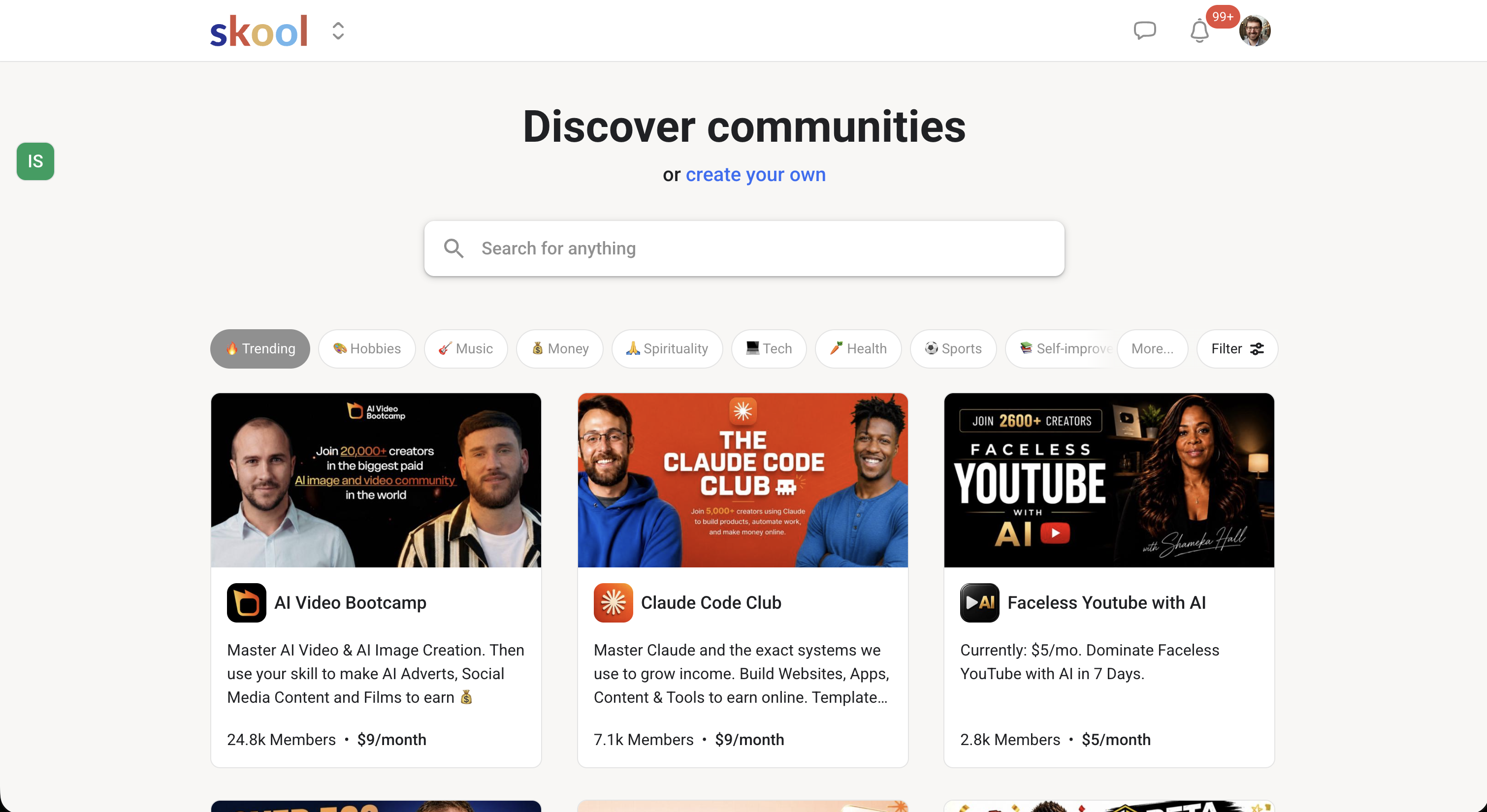
Skool is gaining popularity with creators, coaches, and online educators who want a simple way to combine community and courses.
One of its biggest differentiators is its gamification.
Members can earn points, level up, and participate in ways that make the community feel more active than others.
This can work really well for some communities, especially ones centered around learning and where participation really matters.
Skool Pros
Skool is simple.
It combines community, courses, and gamification in an easy-to-understand way.
It can work well for education-based communities, where you want members to actually participate and keep coming back.
This platform really isn’t trying to do everything, which can be a big green flag if you want a cleaner experience.
And as a side note, if you follow Alex Hormozi and his business advice, Skool’s alignment with his brand can be a plus.
Skool Cons
Skool may feel a bit limited if you want deeper customization, better branding, or simply a more flexible platform.
The gamification can also be a downside, depending on your audience. In some groups, points and leaderboards can increase engagement. While in others, it might feel too much like an actual school.
Pun intended there… unfortunately.
The other big concern a lot of creators have with Skool is the discoverability feature. It’s easy for members and owners from other communities to pop into yours and poach your hard-earned members. This isn’t a deal killer on its own, but definitely something to be mindful of!
Best Use Cases for Skool
- Course communities
- Coaching groups
- Accountability-based groups
- Learning communities
When to Choose Skool
I would choose Skool if you want a simple community and course platform with built-in gamification.
Skool can be extremely useful if your community is centered around learning, participation, and accountability.
It also has a very budget-friendly entry point, which is one reason it’s grown like it has.
But if you want a more branded, flexible, or all-in-one creator business platform, you might consider alternatives like Sphere or Circle.
How to Choose the Best Online Community Platform for You
So… how do you actually choose an online community platform then?
It will really come down to just one thing:
Fit.
Not the longest feature list.
Not the platform that your favorite creator already uses.
It’ll be the platform that best supports the kind of community you actually want to build.
So before you sign up, ask yourself these four questions:
1) What kind of community am I building?
Every community has different needs.
A paid community needs memberships and ownership.
Coaching communities need accountability.
A gaming community needs real-time chat and voice channels.
A course community needs structure and educational features.
My point is, you need to figure out what your members actually need before you choose a community platform.
2) Do I want conversation or a chat room?
Some communities will thrive on fast-paced conversation features or live streams.
Others benefit from slower and more thoughtful discussions in threads.
This is why a Discord server can feel energetic to some while, for others, important conversations disappear in moments.
More structured platforms make it easier for members to find discussions, ask questions, and return to the information they need later.
3) Am I building on someone else’s platform?
Social media platforms are fantastic – and arguably necessary – for attracting attention, but they’re not always great for ownership.
If your entire community lives on someone else’s algorithm-driven platform, you’re forced to play by their rules. Algorithms change, features change, and so do policies.
Owned community platforms give you much more control over the relationship you’re trying to build with your members.
4) How many features do I actually need?
Creators have a bad habit of chasing feature lists. I am no exception here…
Courses.
Funnels.
Automations.
Landing Pages.
Analytics.
The truth is, you likely won’t need every feature on day one, or even on day 1000.
Start with the platform that best supports you and your members, not necessarily the one with the flashiest marketing page.
Just make sure the platform you choose can scale with you as you grow. You don’t want to be stuck without the features you need after growing on one community platform for years!
Final Thoughts
I hope one point has become abundantly clear here at the end of this comparison:
The best online community platform isn’t the one with the MOST features!
It’s the one your members (and yourself) will actually enjoy coming back to day after day.
If you need real-time chat, Discord might be the answer.
If you’re testing a free audience community, maybe Facebook Groups is the place to start.
If you’re building courses and digital products, then Kajabi or Circle could be the better fit.
And if you’re a creator who wants to build and own your community with memberships, content, courses, and deeper relationships with your members, then Sphere is one of the strongest options out there today.
Because at the end of the day, a community isn’t just about where your people are gathering.
It’s about what happens once they get there.
So choose the platform that helps you create the experience your members will actually want to be a part of.
And if you’re ready to build a community you truly own, get started with Sphere today.
Good luck growing your online community! Hopefully, I’ll see you inside Sphere.