
![Is MySpace Coming Back? [What It Means for Creators!]](/images/post/MySpace-returning.jpg)
Is MySpace really coming back?
Yes… probably?
MySpace’s current owners (it has changed hands a few times), brothers Chris and Tim Vanderhook, have publicly said that they intend to relaunch the once-king of social networking platforms.
But as of right now, there seems to be no concrete launch date, no roadmap, and no real idea of what a “new” MySpace will actually look like.
So yes, it seems a MySpace comeback appears to be in the cards.
But I actually think there’s a much more interesting question here – especially for creators:
Why are so many people excited about MySpace making a comeback in the first place?
Because I really don’t think millions of people suddenly woke up desperate to rearrange their Top 8 again…
I do think, however, that people miss when social media actually felt social.
And if you’re a creator like me, trying to build an audience, a business, or an online community in 2026, this is something worth paying VERY close attention to.
So let’s talk about it!
Is MySpace Coming Back? Here’s What We Know So Far
First off, let’s go ahead and separate what we actually know from all of the nostalgia-fueled speculation online at the moment.
Chris and Tim Vanderhook own the MySpace brand right now, and they recently confirmed that they plan to relaunch it when they believe the timing is right. This also isn’t their first go at reinventing the platform either.
After acquiring MySpace, they had previously rebuilt and modernized it with a big focus on its artist and musician community, but that version never came anywhere close to recapturing the original MySpace’s popularity.
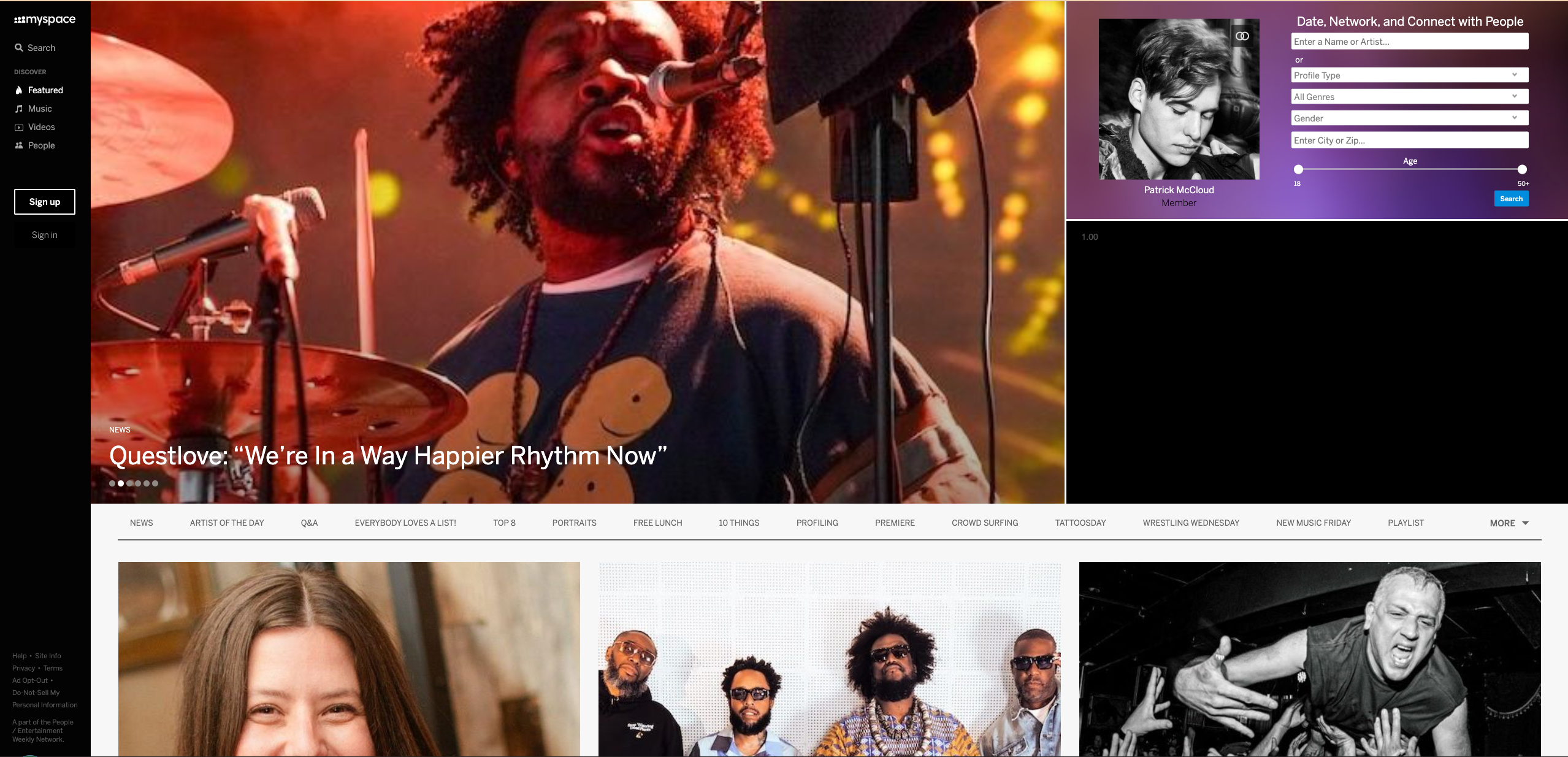
Also worth noting is that MySpace never technically vanished completely. The website still exists today, and I was even able to sign in to my account, although it obviously looks nothing like the cultural phenomenon that so many of us remember from the mid-2000s.
What we don’t know might actually be much, much bigger:
- When will it launch?
- What will it look like?
- Will music still be their focus?
- Will profiles be customizable?
And most importantly: will Tom automatically be our first friend again?
Okay, that last one is my selfish request and isn’t likely.
But for now, I’d look at “MySpace is coming back” as a very real intention, rather than a done deal that’s right around the corner.
Why Are People So Excited About MySpace Again?
What makes people excited about MySpace in 2026?
Nostalgia, of course!
For those of us who actually used MySpace, certain things immediately trigger happy memories in us.
Your Top 8.
Your profile song (I discovered so many bands this way).
Wildly customized pages, some of which are quite unreadable.
Choosing exactly what your little corner of the internet looked and sounded like.
And the absolute social warfare that could ensue when somebody suddenly disappeared from another person’s Top 8… You really just had to be there, IYKYK!
Vogue recently covered the growing interest in a potential MySpace comeback and made what I think is a really great point: that the nostalgia seems to go deeper than old features and Y2K aesthetics.
That people remember MySpace so fondly because it represents a time when the internet felt more like a place you wanted to participate in, instead of somewhere you went to perform. (More on that later.)
And THAT is where I think this gets interesting!
Because I don’t necessarily believe that people want the literal 2006 MySpace back.
What they seem to miss is what being online felt like on MySpace in 2006.
When Did Social Media Stop Feeling Social?
Early social media was truly more like social networking.
You logged in to see what your friends were doing.
You visited someone’s profile because you actually wanted to see their page.
You discovered bands, new hobbies, fandoms, music scenes, and other people all because your interests overlapped and you could actually find them.
It was all so much more intentional.
Compare that with opening TikTok or Instagram today.
You might see your friends or someone you follow.
Or, you might spend the next 45 minutes watching people you’ve never met before make sourdough, rebuild an engine, argue about politics, or explain why you’ve been cutting onions wrong your entire life.
And don’t get me wrong here…
The interest-based algorithms can be incredible for discovery as a creator.
They can put your work in front of someone who never would have found you otherwise. But they also fundamentally changed the relationship between creators and their audiences.
Because following someone no longer guarantees you’ll regularly see their posts. In fact, sometimes you won’t see them for months at a time even – especially if they post about whatever's on their mind, rather than sticking to a very consistent topic area.
These days, the platform decides what deserves your attention based on what it thinks will keep you watching and hooked on the app.
Vogue even reported that users are increasingly retreating from public posting while flocking to smaller online communities where their participation actually counts for something, instead of a performative rat-race.
And I really don’t think that’s a coincidence.
Social Media Has Become Performative
Creators will likely understand this better than anyone else.
Think about everything that goes through your head right before you post something to social media.
Is the hook strong enough?
Will people watch past three seconds?
Should I have text on the screen?
Is this searchable?
Is the thumbnail clickable?
Will people want to share this?
Will the algorithm push it?
Before you know it, you’re not really posting something because you wanted to share it anymore…
You’re producing a "piece of content."
And regular users have been pushed toward that same mentality as of late.
Your Instagram profile became a highlight reel.
Your posts became part of your personal brand.
Everything starts to feel oddly permanent and polished, and deviating from that is anxiety-inducing.
Vogue also goes on to describe mainstream social media platforms today as increasingly commercial and performative, while pointing toward smaller platforms and communities where people are contributing and interacting instead of just optimizing themselves for attention.
Now compare that with the old MySpace.
MySpace was messy!
Your page could be ugly.
Your song could automatically start blasting the second someone opens your profile, and you could hide it with HTML so they couldn’t hit pause.
You could customize the place endlessly.
Not every thought needed a hook, nor did everything need to go viral.
Sometimes you were just… online.
What Does a MySpace Comeback Mean for Creators?
So, here’s where I think creators will need to be careful…
The big takeaway from all of this isn’t to delete Instagram, abandon YouTube, and move your entire business over to MySpace.
Please, don’t do that.
Because these modern social platforms are still incredibly powerful discovery engines, and if you’re trying to grow as a creator, you will likely need them for the foreseeable future.
But the public’s reaction to MySpace should tell us something about what people are starting to look for after discovery.
They want somewhere deeper to go.
They crave actual conversations.
They want shared interests and smaller spaces where their participation actually matters.
And they want to feel like a person, instead of just another impression being fed through someone’s analytics dashboard.
Crazy ideas, right?
This goes directly back to something we’ve talked about before here at Sphere: the difference between the Attention Game and the Ownership Game.
Because social media is amazing at helping you win attention.
But attention alone only goes so far, especially for an entire creator business when an algorithm controls whether you can reach the people who already decided to follow you.
Whereas an online community gives your most invested and engaged audience members somewhere to land and take that relationship further.
No, Sphere Is Not the New MySpace
Let me make one thing VERY clear before someone misunderstands what I am trying to say here…
Sphere is not trying to be the new MySpace.
The two platforms serve entirely different purposes.
MySpace was a massive social network, built for people to create profiles and connect across the internet.
Sphere is a platform for creators to build their own dedicated communities with intention.
The connection between the two isn’t really about features, but about what people seem to want.
Smaller spaces.
Shared interests.
Actual conversations, participation, relationships.
A sense of belonging.
That’s why I find this entire MySpace revival hum so interesting from the perspective of what we’re building here at Sphere.
I already use social media heavily as RyanisHeartless because YouTube, Instagram, and TikTok are how musicians discover me.
And I absolutely do NOT want to replace all of that.
But when someone watches my videos for months on end and decides that they want something more than just another 30-60 second guitar riff to scroll past during their lunch break, I have Heartless Audio on Sphere waiting for them to take that next step.
My Sphere is where they can ask me questions.
They can share their own music and riffs.
They can access my courses and lessons.
And more importantly, they can actually talk to and interact with other musicians inside my community.
Social media created the discovery opportunity for me.
But my Sphere community creates the relationship.
What Creators Can Learn From the MySpace Nostalgia
Whether this “new” version of MySpace succeeds, or completely crashes and burns, honestly isn’t even the most important part of this story…
The reaction itself is the trend we should all be watching.
It proves that people still want to find their people online.
They still want to find those niche spaces built around music, hobbies, fandoms, goals, and professions.
They want places where their contributions actually matter and make a visible difference.
And increasingly often, they seem tired of every single online interaction being filtered through some interest-based algorithm designed to maximize attention and retention.
So build your audience on social media, sure… but give your true fans somewhere to land.
Use those giant platforms for what they’re actually incredible at: discovery.
Then, create a space where your relationship with the people who care the most about your work can become something bigger and more meaningful than a view, like, or a scroll.
Is MySpace Really Coming Back? [The Bottom Line]
So, yes…
The current owners of MySpace say they’re bringing it back. We just don’t know exactly when, what it will look like, or whether anyone will actually stick around once the initial nostalgia wears off.
And I’d be lying if I said that I wasn’t at least a TINY bit excited about it!
But I think focusing only on whether MySpace itself succeeds or not misses the bigger story.
Maybe people don’t actually want 2006 back.
Maybe we don’t need glitter-covered profiles, autoplaying emo songs (guilty), and friendship-ending arguments over who deserves the #1 spot in our Top 8 again.
But maybe, just maybe, the old internet understood something that we seem to have slowly lost:
People don’t just want more content to consume mindlessly.
They want spaces to actually participate in.
Social media has become so incredibly good at capturing our attention, and now creators have a real opportunity to take some of that attention and turn it back into real relationships.
And if you’ve already built an audience that wants something more, you don’t need to wait around for MySpace to figure that out for you.
Create your own Sphere give your people somewhere to land, and start building the kind of internet we all apparently miss so damned much.
Good luck, and I will see you all on Sphere!